

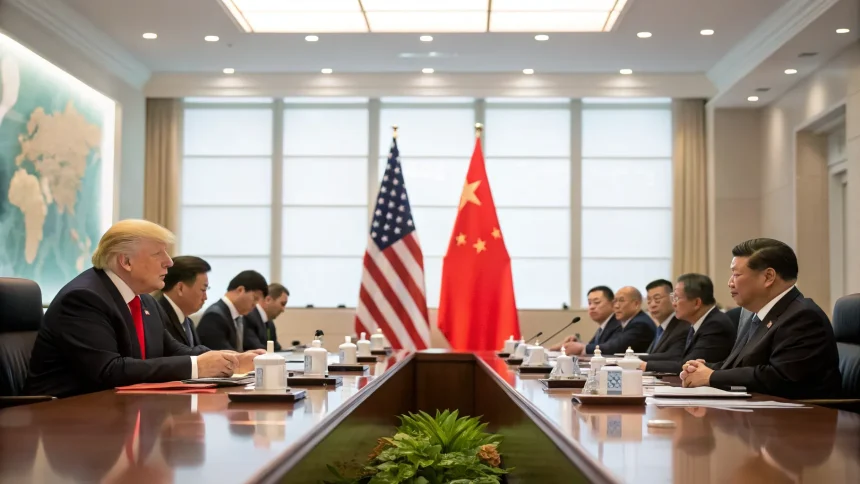
As President Donald Trump meets China’s Xi Jinping, OpenAI executive Chris Lehane is calling for a U.S.-led global body to govern artificial intelligence that includes China. His stance spotlights a rare area where rivals may work together. It also raises hard questions about who sets the rules and how they are enforced.
Lehane, OpenAI’s vice president of global affairs, supports a new institution to coordinate safety norms, testing, and crisis response. He argues that leaving China out would weaken any system. The timing gives the idea a diplomatic opening while the two leaders discuss strategic ties.
Why the call comes now
Governments have been racing to set guardrails for fast-moving AI. The G7 launched the Hiroshima AI process in 2023. The United Kingdom hosted an AI Safety Summit that same year with China at the table. The United Nations backed a broad AI resolution in 2024. The U.S. and China also held technical AI talks in Geneva in 2024, signaling a channel for dialogue.
Yet national rules vary. The European Union moved ahead with the AI Act. The United States has relied on executive action and sector guidance. China has issued content rules and licensing. Large models and cross-border chips tie these systems together. That makes coordination harder, but also more urgent.
“OpenAI VP Chris Lehane supports creating a global AI governance body led by the U.S. that includes China, amid Trump’s visit for talks with Xi Jinping.”
What a global body could do
Supporters say a standing institution can reduce risk and confusion. It could set shared testing baselines for powerful models. It might track incidents and coordinate rapid responses. It could also publish public reports to inform lawmakers and the public.
- Common safety tests and reporting templates
- A registry for high-risk systems and data centers
- Channels for joint investigations after failures
- Voluntary export and compute transparency measures
Design would matter. Experts argue for clear mandates, limited scope, and open participation by industry and civil society. Funding and data access rules would decide whether it has teeth or becomes symbolic.
U.S. leadership, with China inside the tent
Lehane’s framing places the U.S. at the helm while keeping China inside the system. Backers see benefits. Washington can pair technical capacity with alliances. Beijing’s participation would help cover the full supply chain and a major developer base.
Critics warn of risks. Some fear a forum could trade safety for geopolitics. Others say sensitive model data and compute figures could leak. Human rights groups worry about weak privacy standards. Industry wants clarity that does not lock in today’s leaders or block open research.
How this compares to past models
Observers point to templates. The Intergovernmental Panel on Climate Change aggregates science to inform policy. The International Atomic Energy Agency runs inspections with member states. AI may need a hybrid: science review plus safety audits for certain systems.
Unlike carbon or nuclear fuel, AI is software-driven and spreads fast. That suggests lighter global rules paired with stronger national enforcement. A U.S.-led forum could publish metrics and red-team methods. States would then tie access to markets and chips to compliance.
What could emerge from the talks
No treaty is on the table now. But officials could agree on steps that build trust. These include sharing red-team findings on extreme risks, notifying each other after serious incidents, and expanding scientist-to-scientist exchanges.
Businesses seek predictability. Clear testing norms and transparency can lower insurance costs and speed audits. Universities want rules that protect research while limiting misuse. Civil groups push for bias testing and due process when AI affects jobs, health, or services.
The road ahead
Lehane’s support adds a notable tech voice to a policy debate. The next phase will test whether talk becomes structure. Any body will need buy-in from the U.S., China, the EU, and other key producers and users.
Watch for pilot projects on shared evaluations, a public incident database, and compute reporting for the largest training runs. If those pieces take shape, a formal institution could follow. If not, fragmented rules may harden, raising costs and risks for everyone.
The visit creates a window, but it will close fast. A practical, narrow mandate with strong transparency could turn this idea into action.