

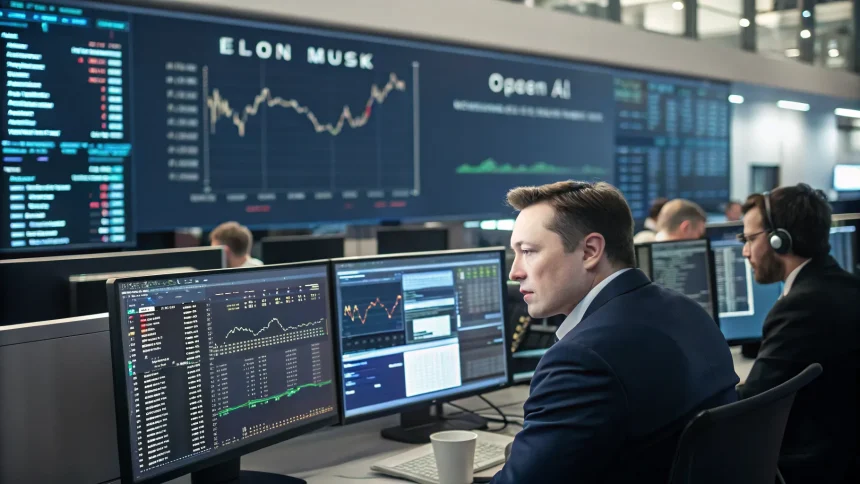
Investor attention is zeroing in on Elon Musk’s legal clash with OpenAI, with trading tied to the case ranking near the top of market interest. Recent activity shows contracts linked to the lawsuit drawing the second-highest volume among live events focused on the billionaire, reflecting strong curiosity about how the dispute could shape artificial intelligence and tech leadership.
Out of all live events related to Elon Musk, trading activity on his suit against OpenAI is the second highest out of all contracts related to the billionaire.
The surge comes as traders weigh legal risk, corporate strategy, and policy questions raised by the case. The trend suggests that even incomplete courtroom battles can move sentiment, prices, and attention across the AI sector.
How a lawsuit became a market event
Legal cases involving high-profile founders often become trading themes. Here, the stakes touch the direction of AI research, business models built on large language models, and investor views on who will lead the next phase of the industry.
Musk helped start OpenAI as a nonprofit in 2015 and later left its board. In early 2024, he sued OpenAI and its leaders, arguing the group shifted from its original mission as it partnered with major backers and built commercial products. He later moved to dismiss the suit without prejudice, leaving questions about future action. Those twists gave traders clear events and timelines to price.
What the activity may be signaling
Heightened trading does not reveal outcomes, but it does show where participants see uncertainty and possible catalysts. The interest in Musk’s case points to a belief that changes in governance or strategy at major AI labs could ripple across valuations and partnerships.
- Policy risk: Debates over safety commitments and nonprofit oversight could affect how labs disclose and manage models.
- Competition: Any shift at OpenAI or rival ventures may influence hiring, capital flows, and product roadmaps.
- Legal precedent: Future suits over AI research, data use, or board duties could follow similar arguments.
Background: From founding ideals to commercial pressure
OpenAI began as a nonprofit research group aimed at building AI that benefits society. As training costs rose, it created a capped-profit arm to raise funds and speed product work. That structure, and the release of successful tools, drew scrutiny about how closely the organization was sticking to its founding aims.
Musk, who runs Tesla, SpaceX, and social platform X, has backed his own AI efforts, including an xAI initiative. His criticism of OpenAI’s direction made their split a public theme. For markets, this history matters because it links courtroom filings to business momentum and deal-making across the AI field.
Industry impact: Reading the tea leaves
If legal pressure or governance reviews push AI labs to adjust disclosures or research priorities, technology roadmaps could slow or shift. That would affect developers who rely on model access, cloud partners that sell compute, and companies building services on top of AI APIs.
On the other hand, if the dispute fades, market interest may rotate to performance benchmarks, model releases, and enterprise adoption rates. Either path helps explain why traders are active: both carry material consequences for revenue, hiring, and valuations.
What traders are watching next
Participants are tracking a few core signals:
- Any renewed legal action or settlements involving Musk and OpenAI.
- Disclosures about safety boards, nonprofit oversight, and profit caps at AI labs.
- Funding rounds, partnerships, and developer platform shifts that hint at strategy changes.
- Regulatory moves on AI safety, data, or competition that could reframe the dispute.
The current ranking—second among Musk-focused live-event contracts—suggests a deep pool of traders think the fallout could touch products, policy, or leadership across the sector. Even absent a courtroom finale, the case has become a proxy for bigger questions: who sets AI’s rules, who benefits from its growth, and how power is distributed between nonprofits, investors, and founders.
For now, the takeaway is clear. The market is treating the Musk–OpenAI fight as more than a headline. It is a signal of where risk and opportunity may emerge next. Watch for legal filings, governance updates, and capital flows. Those clues will show whether this surge in trading marks a passing spike—or the start of a new phase in the AI story.