

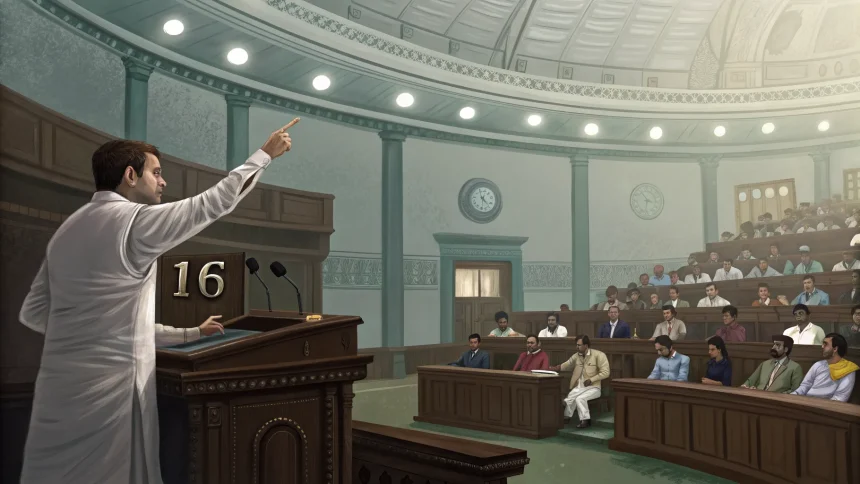
A cryptic “number 16” remark by Congress leader Rahul Gandhi in the Lok Sabha set off a fresh round of speculation and partisan sparring, adding tension to an already charged session. The comment, made during a debate that included the Prime Minister’s address, drew attention inside and outside Parliament as Gandhi framed it as a riddle with no immediate answer.
Gandhi hinted that the riddle linked to the date of the Prime Minister’s speech, but he offered no details. Outside the House, he kept the suspense alive, saying he would explain the meaning only after he “solves it.” The lack of clarity fueled debate about intent, timing, and the political message behind the number.
The remark and the immediate fallout
Inside the chamber, Gandhi’s line drew quick reactions as members tried to read meaning into the number. The Congress leader kept the focus on a single phrase while avoiding further explanation.
“Number 16.”
“16 is the answer to the puzzle.”
He later referred to his words as a riddle and declined to elaborate. The choice to tease rather than explain left the field open to interpretation and stirred intense online discussion. Supporters cast the move as clever messaging. Critics called it a distraction from substantive debate.
Background: Language as strategy in Parliament
Indian parliamentary debates often lean on symbolism, memorable lines, and pointed barbs. Leaders from both sides have used brief phrases to set the tone, change headlines, or draw attention to dates and events. Such tactics are common during high-stakes sessions when party narratives harden and small signals can carry weight.
Gandhi’s approach fits that pattern. A short, repeatable phrase can dominate the news cycle and force opponents to respond. Ambiguity gives a speaker room to shape the story later, depending on how the public and the media react.
Reading the ‘16’: theories and caution
Without an official explanation, guesses about the number spread quickly. Some observers tied it to the date of the Prime Minister’s speech. Others floated unrelated political associations, though none were confirmed.
- Date-driven clue: a reference to the calendar day of a key address.
- Numerical signaling: a hint intended to spark debate rather than deliver facts.
- Media tactic: a hook to keep cameras and questions trained on the opposition’s line.
Analysts urged caution. Numbers can overheat a debate without adding substance, and unclear signals can dilute attention from policy or legislation. Still, in an environment where seconds of airtime matter, the tactic can be effective in shaping coverage.
Impact on the session and public discourse
The riddle added friction to a session already marked by sharp exchanges. It shifted focus to personality and message control, at least for a news cycle. For the ruling side, the safest path is to dismiss the remark as theatrics. For the opposition, keeping the mystery alive can extend the story.
Gandhi’s choice also shows how political actors now manage narratives across platforms. A line dropped in the House is amplified on television, clipped for social media, and debated by influencers before any official follow-up. That echo chamber raises the stakes for even the shortest phrase.
He called it “a riddle” and said he would “reveal the answer only when he solves it.”
What to watch next
Two questions will shape the fallout. First, will Gandhi decode the line with a concrete link to policy, performance, or political math? Second, will the ruling party choose to ignore the tease or counter with its own framing?
If a clear explanation comes soon, the number could anchor a broader argument about governance or accountability. If not, it may fade as a brief media flash, remembered more for its mystery than its meaning.
For now, the “number 16” has done its immediate job: it redirected attention, sparked debate, and put pressure on both sides to define what comes next. The answer, when it arrives, will decide whether this riddle advances a case—or was only a headline for a day.