

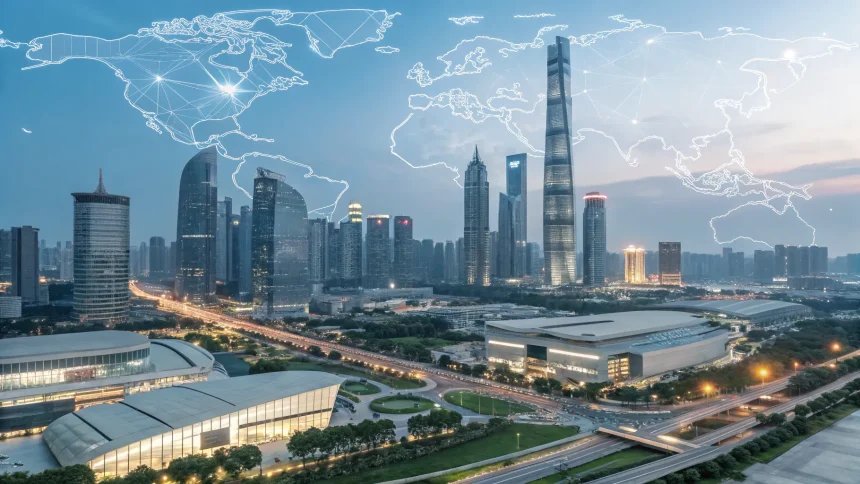
Global investors are channeling money into electronics and artificial intelligence across Asia, even as India reports a short-term slide in foreign direct investment. Analysts say the shift reflects a broader reordering of supply chains and risk management, rather than a pullback in growth. The message is that the world economy remains steady despite political shocks.
“Global capital is increasingly directed towards the booming electronics and AI industries in Asia.”
“The recent dip in India’s foreign direct investments poses little threat.”
“The world economy demonstrates impressive resilience in the face of geopolitical challenges.”
Why capital is moving into Asian tech
Electronics and AI projects demand large up-front spending, reliable infrastructure, and skilled labor. Several Asian hubs now offer these at scale. Investors are following the buildout of chip packaging lines, data centers, and advanced manufacturing parks that can serve global demand.
Money is also tracking policy incentives. Tax holidays, land grants, and faster clearances have become common tools to anchor long-term plants. As firms diversify suppliers and bring production closer to end markets, fresh capital prefers locations that can ship quickly and absorb shocks.
India’s FDI dip in context
India’s short-term decline in inbound funding may look worrying. But analysts argue it reflects timing choices rather than waning interest. Large projects often close in uneven waves, and service exports can offset slower factory commitments during a single quarter.
New manufacturing schemes, including incentives for electronics assembly and components, continue to draw interest. Investors also track infrastructure upgrades and state-level reforms that can trim costs. The current lull, they say, is not a trend by itself.
- Project finance for AI and electronics can be lumpy across quarters.
- Policy incentives and logistics improvements shape the timing of inflows.
- Diversification efforts can shift funds across several Asian markets at once.
Geopolitics and supply-chain resilience
Companies are spreading production to limit exposure to conflict, sanctions, and transport bottlenecks. Multiple sourcing in Asia has replaced single-country layouts. This reduces the risk that one event can halt deliveries.
Trade policy uncertainty still raises costs, but firms are learning to manage it. Insurance, inventory buffers, and dual suppliers are now standard. The result is slower, more cautious rollouts of capacity, yet steadier output over time.
The outlook described by analysts is one of adjustment rather than retreat. The quote about “resilience” captures how businesses have adapted operations and finance to keep goods and services flowing.
What the shift means for growth
More AI spending lifts demand for chips, sensors, and cloud infrastructure. That pulls capital into regions that can deliver at scale. It also creates opportunities in education, power, and logistics as new plants require trained workers and stable energy.
India can still benefit. Assembly ecosystems often evolve into local supplier networks, creating room for component makers and specialized services. If funding is uneven across quarters, the buildout can still trend higher over a year or two.
For governments, the priority is clear: keep rules stable, speed up clearances, and target gaps in power, ports, and land. For firms, the focus is on total cost, time-to-market, and policy clarity.
Signals to watch next
Investors will look for fresh announcements of semiconductor packaging, AI compute hubs, and power projects. Movement in export data for electronics parts can flag where capacity is coming online. Hiring plans by contract manufacturers also offer early clues.
In India, progress on industrial corridors and renewable power links could draw another round of long-term commitments. Across Asia, the durability of AI demand and consumer electronics upgrades will decide how far the current wave runs.
The immediate takeaway is measured optimism. Capital is not retreating; it is reallocating. A dip in one market does not define the cycle when supply chains and policy support are pulling investment into AI and electronics. The next phase will hinge on execution: building plants on schedule, securing skilled labor, and keeping trade channels open.