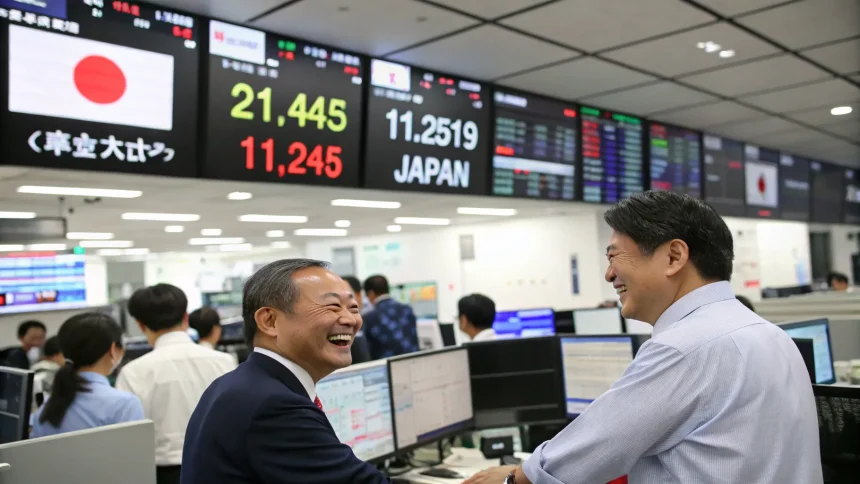
Global markets jolted higher after a late-Tuesday post from President Donald Trump said a U.S.–Japan trade deal was reached, sending the three largest U.S.-listed Japan exchange-traded funds up about 4.5% on Wednesday. The swift move signaled a fresh burst of risk appetite as investors tried to price in the economic and policy effects of a new agreement between two of the world’s largest economies.
“President Trump posted late on Tuesday that a trade deal was reached between the US and Japan.”
While the details of the deal were not immediately public, the market reaction was clear. Traders bid up broad Japan equity funds, betting that reduced trade friction could lift corporate earnings and stabilize cross-border supply chains. The rally arrived at a sensitive moment for global growth, with investors hoping for fewer trade shocks and clearer rules for exporters and importers.
Why the headline mattered to markets
Trade headlines can move prices fast because they shape expectations about costs, demand, and currency moves. Japan’s stock market is heavily exposed to global trade. Signals that tariffs may ease, or that market access could improve, often lead to a bounce in shares tied to manufacturing, autos, and technology suppliers. Even without deal specifics, funds tracking Japan equities tend to react to the prospect of smoother commerce and steadier profits.
“The three largest U.S.-listed Japan ETFs each gained around 4.5% on Wednesday.”
ETFs are a useful barometer in such moments. These funds trade in real time, translating sentiment into prices within minutes. A near 4.5% single-session move suggests traders saw the post as credible and material, at least in the short run.
What could be at stake
Typical trade deals can touch on tariffs, quotas, standards, and market access for goods and services. Even narrow agreements can reduce uncertainty for exporters and ease compliance burdens. For U.S. and Japanese companies, fewer surprise barriers can mean cleaner order books and more predictable capital spending.
- Lower trade frictions can support earnings by cutting costs.
- Clearer rules can unlock investment that had been on hold.
- Supply chains may see fewer delays and rerouting expenses.
Investors will look for concrete measures in the final text. Tariff schedules, implementation dates, and any carve-outs for sensitive sectors will shape the durability of Wednesday’s surge. They will also watch for enforcement tools and timelines, which determine how quickly firms may adjust plans.
Reading the signal in ETFs
Moves in large Japan-focused ETFs often mirror shifts in global risk sentiment. A broad gain across the biggest funds suggests the buying was not limited to a niche theme. That breadth points to hopes for improved earnings across multiple sectors, rather than a bet on one industry alone.
Still, a headline-driven rally can fade if promised benefits are slow to arrive. Without published terms, investors are trading on expectations rather than facts. Currency moves could also influence returns for dollar-based holders, adding another layer of uncertainty until details emerge.
Key questions for policy and business
Policy watchers will focus on how the agreement fits into each country’s economic goals. The size and scope of any tariff changes will matter for inflation and consumer prices. Businesses will weigh whether procurement and hiring plans should change, or if it is wiser to wait for confirmation.
For now, the news gives decision-makers a reason to revisit stalled projects. If the deal lowers barriers, firms tied to trade could add shifts, reopen negotiations with suppliers, or rethink where to place new capacity.
What to watch next
Markets want clarity. An official text, a timeline for implementation, and any legislative steps will determine how much of Wednesday’s gain sticks. Analysts will also track corporate guidance in the coming weeks for signs that managers see a lasting change in demand or costs.
Watch for three signals: the release of the agreement language, sector-level responses in Japan’s equity market, and commentary from major exporters. These will help confirm whether the rally reflects a real shift in outlook or a brief burst of optimism.
The initial reaction is strong, but the follow-through depends on details. If the agreement eases trade friction in a meaningful way, Wednesday’s ETF surge could mark the start of steadier risk appetite. If not, markets may give back gains while they wait for firmer ground.