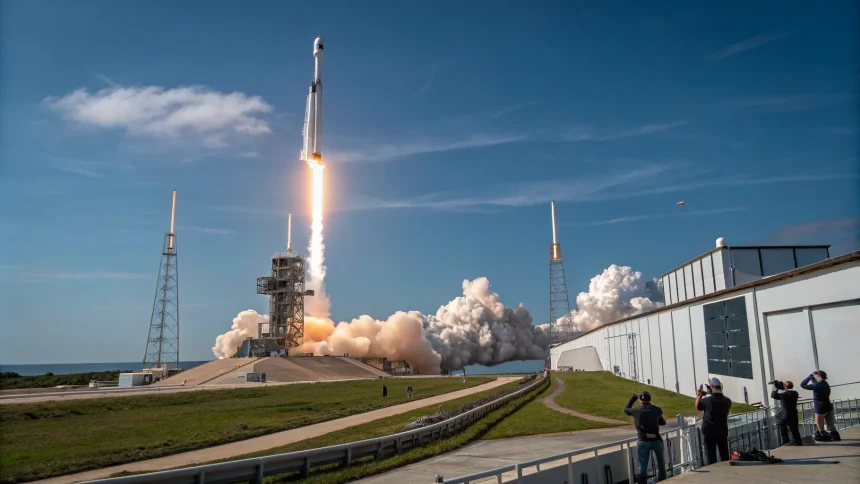
SpaceX has set a new mark in private markets, surpassing the previous high set by OpenAI and signaling fresh momentum for space and satellite businesses. Investors say the milestone reflects growing confidence in reusable rockets, satellite internet, and a race to turn space services into steady cash flow.
The development comes after a year of rapid launches, new contracts, and rising demand for global connectivity. The move places the Hawthorne, California, company at the center of a broader debate over late-stage startup pricing and exit timelines.
The SpaceX valuation vaults past the previous record of US$500 billion that ChatGPT owner OpenAI set in October. Read more here.
How SpaceX Reached the Summit
SpaceX’s ascent rests on two engines: a high-frequency launch business and the fast-growing Starlink broadband network. The company flew missions at a pace unmatched in the sector, reducing costs through rocket reuse and standardization. Starlink, which sells satellite internet to homes, businesses, ships, and aircraft, has expanded coverage and opened new revenue lines.
Investors point to recurring subscription income from Starlink as a key change. Launch is cyclical and tied to schedules. Broadband can produce steadier monthly cash, even if margins vary by region and customer mix.
The company has also tested its next-generation Starship system. While not yet in full commercial service, each test informs designs that could lower the cost to orbit and support deeper space missions. That promise is central to long-term models used by investors.
Private Market Context
The mark surpasses the previous high set by OpenAI, whose growth in artificial intelligence attracted strong demand from global funds. The handoff from an AI leader to a space company shows capital rotating among frontier sectors where scale and data create advantages.
Late-stage private rounds and secondary share sales have become key price signals. With IPO windows still uneven, investors often rely on these trades to set value. That can push prices up when demand is strong and supply is tight.
What’s Driving Investor Optimism
- Launch cadence that cuts costs and increases reliability.
- Starlink’s expanding subscriber base and enterprise use cases.
- Government and commercial contracts that add revenue visibility.
- Prospects for future services, including direct-to-device links.
Together, these factors suggest a path to scale that few rivals can match. Analysts also cite the flywheel effect: more launches support more satellites, which support more users, which fund more launches.
Caution Flags and Open Questions
Some investors warn that private prices can sprint ahead of fundamentals. Launch failures, regulatory delays, or slower Starlink adoption could test assumptions. Capital needs for new vehicles and constellation upgrades remain high, even with rising cash flow.
Regulators are watching satellite traffic and spectrum use. As constellations grow, space traffic management and debris mitigation become more urgent. Costs tied to compliance and safety could rise.
There is also the exit question. An IPO could give early backers liquidity, but public markets may price the business differently. A long wait could strain later funds that need distributions.
Why This Matters for Space and AI
The shift from an AI leader to a space operator at the top of private valuations marks a broader contest for capital. AI firms chase model performance and distribution. Space firms chase launch efficiency and global connectivity. Both need major upfront investment and scale to win.
For governments and defense customers, a stronger SpaceX can reshape procurement, satellite design, and timelines. For telecom providers, Starlink’s growth could pressure pricing in remote and mobile markets. For AI companies, the change is a reminder that investor focus can turn quickly as new revenue lines harden.
What to Watch Next
The next phase depends on execution. Watch for Starship milestones, Starlink subscriber growth, and the mix of consumer and enterprise sales. Track new contracts, expansion into direct-to-device services, and any steps toward liquidity events.
Investors will also watch how rivals respond. Competitors may partner on launches, share infrastructure, or focus on niche services to avoid direct fights on price and coverage.
For now, the market has delivered a clear message. The top private valuation sits with a space company that aims to turn orbit into a predictable business. The coming year will show how much of that promise converts into durable profit and steady cash.