

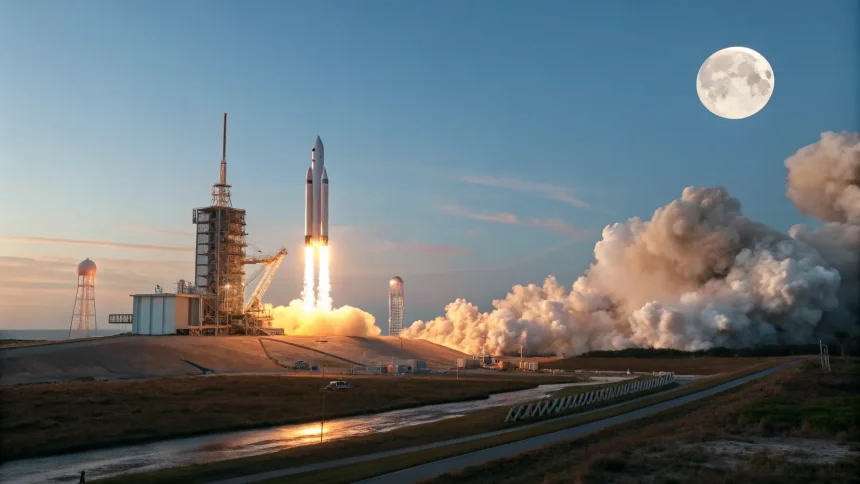
For the first time in more than half a century, a crew is headed to the moon. NASA said it is sending four astronauts into lunar orbit today, a move the agency describes as a key step toward building a permanent base on the surface.
The mission will lift off from the U.S., circle the moon, and test systems needed for long-duration stays. NASA sees the flight as the bridge between past test missions and future landings. The agency says the goal is to return people to the surface and stay.
“NASA is launching four astronauts to orbit the moon today as a step towards a permanent lunar base.”
Why this matters now
No crew has traveled to the moon’s neighborhood since the Apollo era ended in 1972. This flight marks a new phase that shifts from short visits to building a lasting presence. NASA officials argue that sustained access will support science, technology, and future Mars plans.
The agency’s plan includes a small station in lunar orbit and surface habitats designed for weeks-long stays. The mission today is designed to measure how systems perform with humans on board in deep space, where help is far away and conditions are harsh.
Background and context
NASA has spent years developing a heavy-lift rocket and a crew capsule built for deep space. Uncrewed flights have already tested many parts of the system, including high-speed reentry and long vacuum exposure. But a crewed trip introduces new risks and data needs.
The modern lunar program is funded at multi-billion dollar levels and has faced delays. Independent watchdogs have flagged schedule slips and rising costs. Supporters say the investment will pay off in jobs, science, and new industries tied to space resources and communications.
The mission goals
Officials describe the flight as a shakedown for hardware, operations, and teamwork across mission control centers. It will also test life support, navigation near the moon, and procedures for high-speed return to Earth.
- Validate deep-space life support with a full crew.
- Practice lunar flyby navigation and communications.
- Gather medical and radiation data for longer stays.
Engineers will watch how the spacecraft handles long exposure to radiation and extreme temperature swings. Medical teams will track how the crew adapts during the trip and after splashdown.
Voices and viewpoints
Agency leaders frame the flight as a measured move. One official called it a “prove-it mission” that must show repeatable performance. Pilots and flight surgeons in briefings have stressed checklists, crew rest, and margin over speed.
Critics question whether the cost matches the benefit. They argue that private cargo vehicles and robotic missions could deliver many goals at lower price. Space policy analysts also warn that long-term funding can shift with elections and budgets.
Supporters counter that human crews can adapt in ways robots cannot, fix problems in real time, and inspire new talent to enter science and engineering. They point to Apollo’s legacy in materials, computing, and global TV, and argue that modern spinoffs could follow.
Risks and safety
Deep space radiation, docking failures, and heat shield performance are central concerns. NASA says it has multiple abort options during ascent and free-return paths that can bring the crew home if an engine issue arises near the moon.
Redundant systems aim to protect oxygen supply, power, and guidance. Safety panels will review data before clearing future steps, including the first surface landing of this campaign.
What comes next
If the mission hits its targets, NASA plans to assemble an orbiting outpost and send crews to the surface for longer stays. Early surface work would focus on power, habitats, and testing how to use local resources such as ice for water and fuel.
International partners and U.S. companies are lined up to provide parts of the transport, logistics, and science packages. Commercial landers, small rovers, and relay satellites are expected to support crewed work on the surface.
Timelines remain subject to test results, funding, and supply chains. But today’s flight is set to define whether the program can move from promise to steady operations.
As the countdown proceeds, the goals are clear: prove the ship, protect the crew, and bring back hard data. The outcome will shape when a base gets built, who helps build it, and how soon humanity can live and work on the moon for the long term.