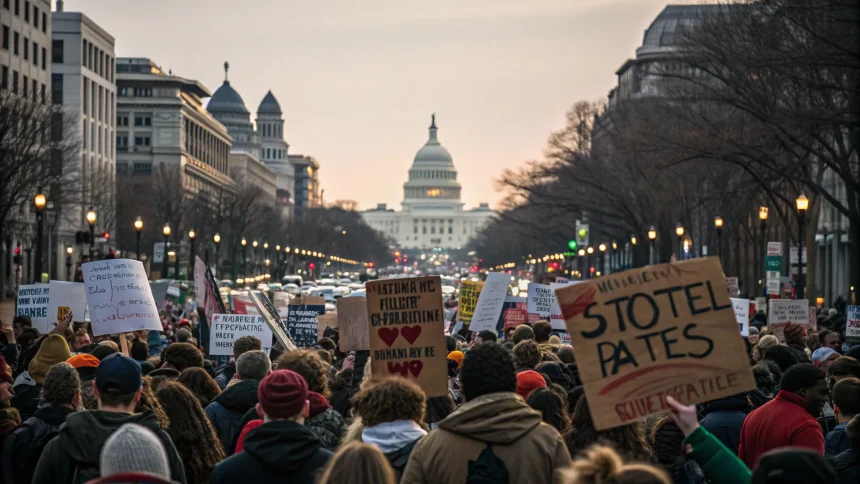
Protesters gathered in cities across the United States after President Donald Trump announced a military operation in Venezuela that he said led to the capture of President Nicolás Maduro. Demonstrations stretched from the White House in Washington, D.C., to Times Square in New York on Monday, as crowds condemned the move and called it an illegal act of war. Organizers said they were responding to fears of a wider conflict and long-standing concerns about U.S. actions in Latin America.
Street Protests From D.C. to New York
Large crowds formed within hours of the announcement. In Washington, marchers moved along Pennsylvania Avenue, holding signs that read “No War” and “Respect International Law.” In New York, traffic slowed near Times Square as groups chanted and banged drums.
“Hands off Venezuela,” protesters shouted.
“Stop bombing Venezuela now,” another group yelled as speakers warned about the human cost of war.
Participants accused Washington of imperialism and questioned the administration’s motives. Some said they feared a prolonged occupation. Others worried about civilian casualties and regional instability.
Legal and Diplomatic Questions
The protests reflected sharp debate over international law. Critics said a cross-border military operation violates the United Nations Charter, which bars the use of force except in self-defense or with Security Council approval. They argued that the capture of a sitting head of state, if confirmed, would inflame tensions across the region.
Supporters of a forceful approach often frame it as a response to a crisis in Venezuela, citing concerns over repression and economic collapse. They say U.S. action is intended to protect civilians and restore democratic rule. Legal scholars remain split on whether any claims of collective defense or humanitarian grounds would apply without explicit international backing.
- Opponents cite the UN Charter’s ban on unilateral force.
- Backers argue the operation aims to end abuses and stabilize the country.
- Regional governments could face renewed migration pressures and security risks.
Political Stakes in Washington
The announcement sparked immediate reaction on Capitol Hill. Lawmakers pressed for clarity on the scope of the mission, the legal authorization, and the exit plan. Past U.S. interventions have prompted debate over the War Powers Resolution, which requires the executive branch to consult Congress and outline objectives and timelines.
Advocacy groups echoed those calls, urging transparency on civilian safeguards and humanitarian aid. Defense officials often warn that urban operations carry high risks. Civilian harm, even when unintended, can fuel backlash at home and abroad.
Venezuelan Crisis Background
Venezuela has faced years of economic hardship, sanctions, and political deadlock. In 2019, the United States recognized opposition leader Juan Guaidó as interim president, deepening a rift with Caracas. The Maduro government endured, backed by parts of the military and supported by allies such as Russia and Cuba.
Sanctions targeted state oil revenues and top officials. The economy shrank, and millions of Venezuelans left the country. Mediation attempts met limited success, and talks repeatedly stalled. Analysts say the lack of a negotiated path kept pressure high and raised the risk of confrontation.
Humanitarian and Regional Impact
Relief agencies warn that conflict could worsen shortages of food, medicine, and power. Border areas with Colombia and Brazil are already strained by migration. A sudden power shift could disrupt public services and supply chains.
Neighboring countries will likely weigh responses in regional bodies and the United Nations. A divided international community could make coordination difficult. Aid convoys, refugee processing, and security cooperation may hinge on whether fighting spreads or subsides.
What Comes Next
Key questions remain. The administration has not detailed the legal basis, the rules of engagement, or the timetable. Diplomats will try to manage fallout while allies seek clarity on objectives and end-state planning.
Protesters say they will keep pressure on Congress to hold hearings and block funding without a clear mandate. They also want firm commitments on civilian protection and humanitarian access.
The next phase will depend on whether Washington outlines a limited mission and a rapid transition plan. Markets, migrants, and regional partners will be watching. For now, the streets of U.S. cities show a country divided over war, law, and the costs of intervention.