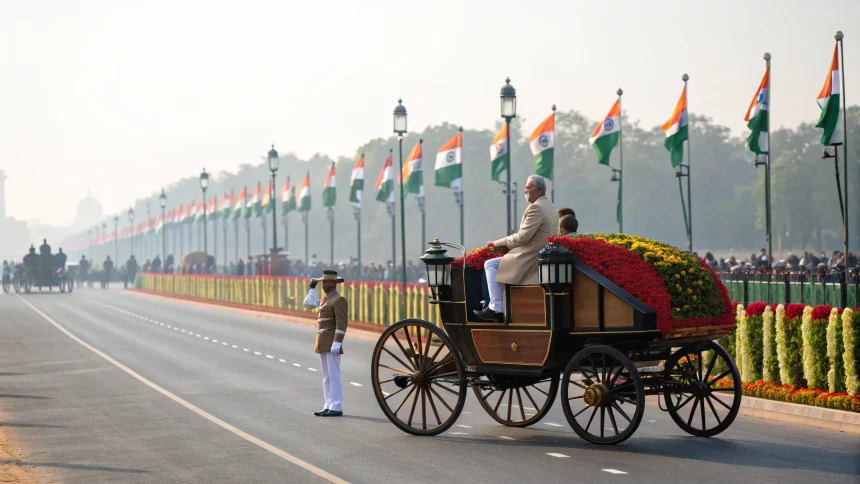
India marked its Republic Day with a striking return to tradition as President Droupadi Murmu welcomed European leaders at Kartavya Path in New Delhi. Prime Minister Narendra Modi received the visiting dignitaries at the saluting base, where the President and the Chief Guests arrived in a horse-drawn carriage for the first time in four decades. The revival added ceremonial flair to the national parade and signaled a renewed emphasis on heritage and state protocol.
The event featured European Council leader Antonio Costa and European Commission President Ursula von der Leyen as Chief Guests. The President’s Bodyguard, the seniormost regiment of the Indian Army, escorted the delegation to the ceremonial avenue. The choice to bring back the “Traditional Buggy” became one of the day’s defining moments and drew wide attention.
Historical Tradition Returns to Kartavya Path
Republic Day honors the adoption of India’s Constitution on January 26, 1950. The annual parade showcases military units, cultural tableaux, and national achievements. Kartavya Path, the parade route, was redesigned in recent years to refresh public space while keeping its ceremonial role intact.
For many years after 1950, state guests and the President arrived by horse-drawn carriage. The practice was halted for about 40 years. Security updates and changing protocols influenced that decision. This year’s return highlighted continuity with early ceremonial customs.
Reviving a tradition discontinued for 40 years, they arrived in the “Traditional Buggy,” adding a regal charm to the celebrations.
The President’s Bodyguard and Ceremonial Protocol
The President’s Bodyguard, known as “Rashtrapati ke Angarakshak,” is the oldest regiment in the Indian Army. It leads mounted escorts and key ceremonial duties for heads of state. Its presence at Kartavya Path signaled the full return of the ornate arrival sequence.
The President and the Chief Guests were escorted to Kartavya Path by the President’s Bodyguard, “Rashtrapati ke Angarakshak,” the seniormost regiment of the Indian Army.
The mounted escort framed the carriage, maintaining a precise formation from the forecourt to the saluting base. The visual effect reinforced the grandeur associated with Republic Day ceremonies.
European Leaders Front and Center
The presence of European leaders as Chief Guests underlined ties between India and the European Union. The EU is one of India’s largest trading partners and a key technology and security collaborator. High-level attendance at Republic Day is seen as a strong diplomatic signal and part of India’s outreach to global partners.
By inviting top European officials, New Delhi emphasized shared interests in trade, supply chains, clean energy, and digital standards. The ceremony offered stagecraft and symbolism while setting a respectful tone for future talks.
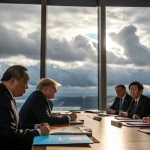
President Droupadi Murmu, along with European Council President Antonio Costa and European Commission President Ursula von der Leyen, the Chief Guests for the Republic Day celebrations, were welcomed by Prime Minister Narendra Modi at the saluting base at Kartavya Path.
Security, Symbolism, and Public Reception
Bringing back the carriage raised questions about security and logistics. Officials balanced tradition with modern safety protocols. The controlled route, layered security, and rehearsed formations sought to meet current standards.
The public reaction centered on pride and pageantry. Many saw the carriage as a respectful nod to history. Others focused on the diplomacy on display, with India showcasing sovereign tradition alongside international partnership.
Why the Revival Matters
- It restores a visible link to early state ceremonies.
- It elevates the role of the President’s Bodyguard in public view.
- It highlights India-EU engagement at a flagship national event.
Such gestures matter in statecraft. They set tone, frame narratives, and provide a backdrop for policy discussions. The visual impact extends far beyond the parade route.
What to Watch Next
The ceremony could influence future state events, where heritage elements may feature more often. If the carriage becomes a regular fixture, organizers will refine security and timing to keep the flow of the parade smooth.
On the diplomatic front, attention will turn to policy talks that follow ceremonial appearances. Trade, clean technology, and defense cooperation are likely to top the agenda.
The day’s images—mounted escorts, the “Traditional Buggy,” and leaders standing together—shaped a clear message. India is leaning on heritage to frame modern partnerships. The result was a carefully staged moment that connected the past with present priorities, and set expectations for deeper engagement in the months ahead.