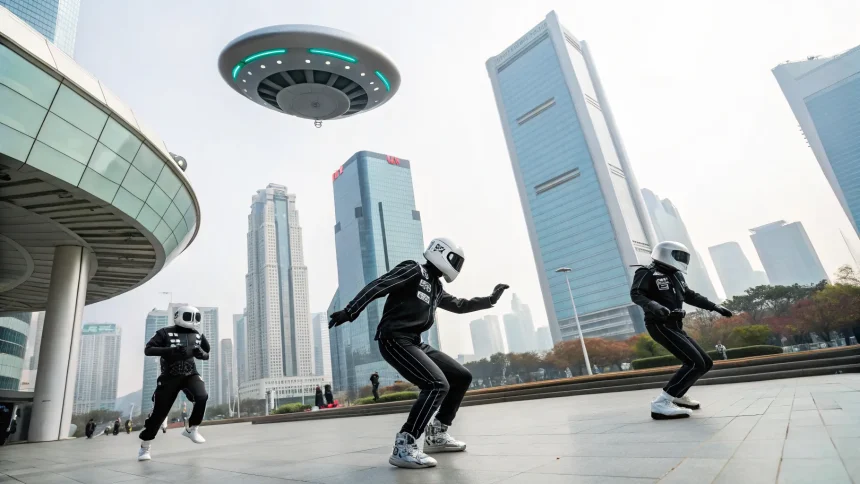
On a weekday in Seoul’s financial district, a scene straight from science fiction played out inside an office designed like a downed spacecraft. Humanoid robots, dressed in sleek black hip-hop outfits, snapped into formation and danced to K-pop hits, while towering astronauts and floating robotic jellyfish loomed overhead.
Humanoid robots dressed in black, luxury hip-hop outfits snap into formation, moving in perfect sync to K-pop songs.
The display, set in a themed simulation space, signals a shift in how companies are testing robots in public-facing roles. It also hints at South Korea’s blend of pop culture and high-tech ambition, concentrated in a district better known for banking than choreography.
A stage for machines and a lab for people
The choice to stage a robot dance floor in a finance hub is more than a stunt. It offers a controlled environment to study how people react to humanoid machines at close range. The set design—a crash-landed spacecraft—amplifies attention and invites casual interaction. That helps engineers observe eye contact, spacing, and comfort levels without the stress of a factory floor.
By pairing machines with familiar music, organizers aim to lower barriers. K-pop is a shared language for many visitors in Seoul. A synchronized routine also becomes a test of motion control, timing, and coordination under bright lights and with a live audience. Those lessons matter for robots that may soon guide customers, deliver items, or perform in-store demos.
It’s a simulation inside an office styled as a crash-landed spacecraft in the heart of Seoul’s financial district, complete with towering astronauts and floating robotic jellyfish.
Why dance matters for the next wave of service robots
Syncing to music forces precise joint control and balance. It challenges sensor fusion and path planning in tight formations. If a robot can hit a beat without bumping a neighbor, it is more likely to navigate a store aisle or an office corridor without errors.
Choreography also trains systems to adapt to cues. Light changes, crowd noise, and unexpected movement demand quick adjustments. Those same skills help robots respond to customers, pivot on a delivery route, or hand an item to a person safely.
- Dance drills timing, which supports safe co-working with people.
- Costumes test fit, grip, and heat under continuous motion.
- Stage props simulate cluttered real-world spaces.
Marketing gold or meaningful progress?
Not everyone sees a dance number as progress. Skeptics argue that polished demos can hide limits in battery life, dexterity, and cost. A routine on a smooth floor does not guarantee steady performance on a carpeted office or a crowded mall.
Supporters counter that public trials are vital for trust and training data. They say live feedback is faster and richer than lab tests alone. The spectacle also draws partners from retail, entertainment, and hospitality. That can turn pilots into real contracts and reveal practical needs early.
Cultural export meets automation
South Korea’s music industry has shaped global pop culture. Merging it with humanoid robotics creates a familiar entry point for international visitors and investors. The setting in a financial district suggests a courtship of corporate clients, who may want robots for events, brand activations, and customer service.
The aesthetic choices—black streetwear, space props, and jellyfish drones—frame robots as stylish and approachable. That framing matters as firms debate where machines belong in public spaces and how they should look while doing the job.
What to watch next
Three signals will show whether dance-floor precision translates into daily work. First, watch for pilots in malls, transit hubs, and large offices. Second, expect updates on safety approvals and insurance coverage for public use. Third, look for evidence of cost control, like swap-and-go batteries or shared charging bays.
If those pieces fall into place, humanoids may step off the stage and into routine tasks, from guiding visitors to lifting light loads. If not, the dance will remain a spectacle with limited reach.
The robots in Seoul have shown they can move with the music. The next test is whether they can move the market. For now, the scene offers a clear signal: culture can be a gateway for machines, and real-world trials are shifting from factories to the front of the house.