

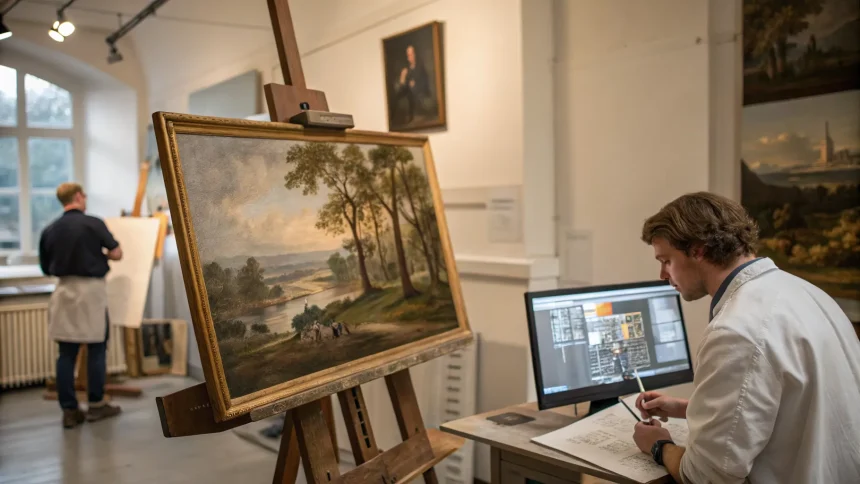
A simple question about a secondhand shop painting has opened a window into how artificial intelligence is reshaping art discovery. A son, curious about the origins of a canvas his mother bought decades ago, turned to an AI model for clues. The exchange shows how tools once reserved for experts are slipping into daily life, and what that could mean for collectors, families, and the art market.
The case highlights a growing trend. People are using image-recognition and large language models to analyze old family pieces, flea market finds, and estate items. The promise is speed and reach. The risk is error. The stakes can be high if an AI hint sends owners chasing false leads or missing a genuine work.
A small question with big stakes
When a son got curious about the origins of a painting his mother bought at a secondhand shop decades ago, Google Gemini had some intriguing thoughts.
The request was straightforward. Identify style, era, or artist. The response, while engaging, raises a key point. AI can suggest paths, but it cannot confirm authorship. That task still falls to trained eyes and documented history.
How AI enters the hunt
Modern tools can compare images across public catalogs and museum sites. They can spot stylistic links and surface similar signatures. They can also summarize known movements and match patterns at scale.
For families, this means faster first steps. A model can propose likely schools of art, such as Impressionism or Abstract Expressionism, and point to related works. It can also draft a plan for next checks, like searching auction records or artist monographs.
What AI gets right—and where it stumbles
AI excels at recall. It scans vast online sources and returns candidates in seconds. It helps owners learn terms and periods so they can ask better questions. It is a useful guide to basic research.
The weakness is confidence without proof. Models can misread signatures, mix artists with similar names, or infer dates from style alone. They can also repeat errors found online. An attractive guess is not a finding.
- AI can flag lookalikes, but lookalikes are common.
- Attribution needs physical study and documentation.
- Market value depends on condition, provenance, and demand.
Provenance remains the anchor
Provenance is the record of ownership, exhibition history, and sales. It is the spine of any serious attribution. Receipts, labels on the back of the frame, gallery stamps, and letters all matter. Without these links, claims rest on sand.
Experts still rely on connoisseurship, pigment and canvas tests, and archives. Museums and artist foundations publish catalogues raisonnés that list accepted works. Insurers and auction houses request documentation before a sale.
Ethics, fraud, and the online market
As more people use AI to assess finds, the risk of inflated claims rises. Sellers may cite an AI hint as proof, even when it is only a lead. Buyers can be misled by confident wording or grainy photos.
Major platforms have tightened rules on attributions. Many require “attributed to,” “circle of,” or “after” labels when origin is unclear. Clear labeling protects both sides and sets fair expectations.
A practical path for curious owners
An AI prompt can spark the search. The next steps should ground it in evidence:
- Photograph the work in natural light, front and back, including edges and any labels.
- Check local and national stolen art databases before sharing widely.
- Visit a regional museum, gallery, or appraisal day for in-person views.
- Search library databases and artist catalogues for matches.
- Request a condition report from a conservator before any sale.
Why this moment matters
Affordable AI has widened access to art research. Families who once lacked tools now have a starting map. Yet the art world still runs on proof, not predictions. The best results come when AI triage meets expert review and solid records.
For the son and his mother, curiosity is the right engine. Whether the painting is a study piece, a student work, or something rarer, the process can protect its story—and its value.
The takeaway is simple. Let AI spark questions. Let documents and experts answer them. Watch for clearer standards from auction houses and marketplaces as these tools spread, and expect better links between image search, catalogues, and trusted archives in the months ahead.