

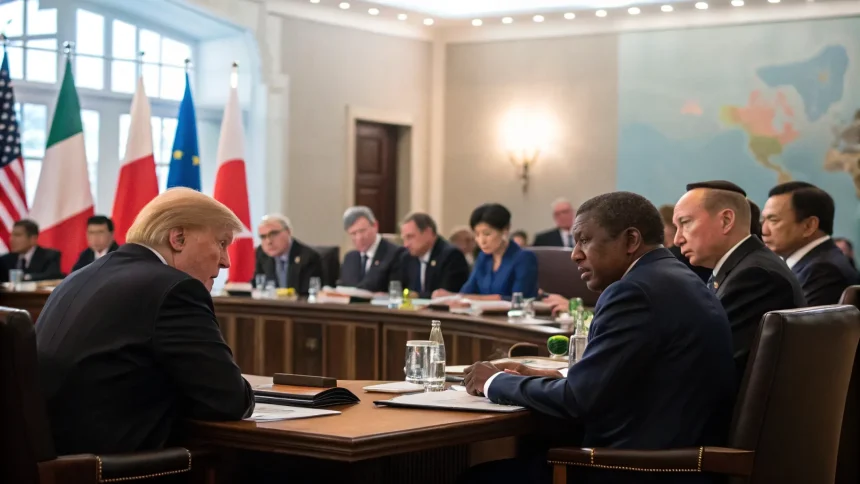
Donald Trump joined world leaders for a high-profile session aimed at finding common ground on hard global problems. The closed-door meeting focused on cooperation and security as conflicts, economic stress, and fast-changing risks test alliances and institutions. The stakes are high, and expectations rise whenever major figures share a room.
Organizers framed the discussion in clear terms.
“Trump gathers with word leaders for a high-profile session focused on global challenges, international cooperation and security concerns.”
The agenda signaled an attempt to tackle big issues in one sweep. It also hinted at the tension between national interests and shared action at a time when trust can be thin.
Why this meeting matters now
Sessions like this often follow periods of strain. War, energy shocks, and inflation have pushed governments to rethink supply chains and budgets. Cyber threats and disinformation add pressure. Leaders also face voters who want security at home but lower exposure abroad.
Trump remains a singular figure in global politics. His approach to alliances and trade has influenced debates on defense spending, tariffs, and industrial policy. Supporters argue that a harder line can secure better deals. Critics warn it can shake partners and unsettle markets.
The issues on the table
- Security: defense commitments, deterrence, cybersecurity, and critical infrastructure protection
- Economy: inflation, supply chains, energy prices, and trade tensions
- Technology: data security, AI risk, and standards that shape cross-border business
- Aid and reconstruction: how to finance support without stretching budgets
- Migration: pressure at borders and the need for legal pathways
These topics link together. Supply chain shifts can raise prices. Energy choices affect both security and climate goals. Tech standards can set the rules for growth and surveillance for years.
Competing views on cooperation
Supporters of strong coordination say pooled action prevents gaps that threats exploit. Joint sanctions, intelligence sharing, and defense planning have been used to check aggression and cybercrime. They argue that unity lowers costs by avoiding duplication and waste.
Skeptics prefer flexible, case-by-case deals. They worry that complex pledges can be slow and blunt. They point to rising domestic costs and voter fatigue with far-off commitments. For them, tighter borders, targeted tariffs, and shorter supply lines feel safer.
The session’s framing—global challenges, cooperation, and security—suggests a search for a middle path. Leaders can match clear national aims with limited, workable projects. That includes joint drills, common tech safeguards, and rules for critical minerals and semiconductors.
Signals to watch
What happens after the cameras leave will reveal the real outcome. Declarations are routine. Concrete steps are harder. Observers will look for timelines, budget lines, and named working groups. They will also watch for any shift in tone from Trump and key partners.
Past gatherings show that small wins can matter. A shared cyber response plan or an agreement on port screening can reduce risk quickly. So can narrow trade pacts that speed goods for essential sectors. Incremental moves, stacked over time, build confidence.
Risks and opportunities ahead
Without follow-through, the session risks signaling more division than unity. Markets can react to signs of discord, and adversaries can test weak spots. Yet a modest package of actions could calm nerves and stabilize expectations.
Clear steps might include publishing joint criteria for critical infrastructure, expanding information sharing on ransomware, and setting a path for energy storage projects. Even partial alignment on export controls would carry weight if tied to enforcement.
The meeting drew attention because the agenda is hard and the players are high-profile. The line between competition and cooperation is thin, and the costs of error are high. If leaders settle on practical tasks they can finish in months, not years, the session could mark a turn toward steadier policy. If not, the debate over how much to coordinate—and with whom—will grow louder.