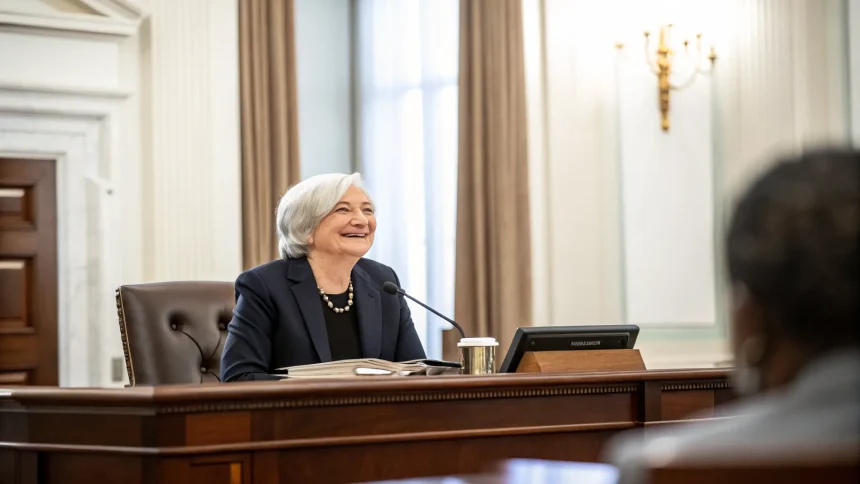
Federal Reserve Governor Michelle Bowman defended the central bank’s independence in an interview ahead of a conference on bank regulation she is hosting, as political criticism of interest rate policy intensifies. Her remarks arrive amid renewed attacks by former President Donald Trump on the Fed and Chair Jerome Powell for not cutting rates, sharpening political attention on how the central bank sets policy.
Fresh Warning Amid Political Pressure
Bowman said it is essential that central bankers remain free from political interference as they set rates to meet the Fed’s dual mandate of stable prices and maximum employment. She did not discuss a specific path for rates, but emphasized the principle guiding those decisions.
“It’s very important … that we maintain our independence with respect to monetary policy,” Bowman said on CNBC, ahead of a day-long conference at the Fed focused on bank regulation.
Trump, who appointed Bowman to the Board of Governors in 2018, has stepped up public criticism of Powell for holding rates higher than he prefers. The clash highlights a recurring fault line in U.S. economic policy: elected officials face voters on growth and jobs, while the Fed is designed to keep a longer view on inflation and financial stability.
A History of Tensions With the Fed
While political pressure on the Fed is not new, recent barbs echo famous episodes. In the 1960s, President Lyndon Johnson pressed Chair William McChesney Martin over rates. In the early 1970s, President Richard Nixon pushed Chair Arthur Burns to ease policy before the election, a move later linked to high inflation.
Since the modern framework for rate-setting took hold, Fed leaders have argued that short-term political demands can lead to longer-term harm if inflation expectations become unmoored. That view gained force after the high inflation of the 1970s and the painful rate hikes under Chair Paul Volcker in the early 1980s.
What Independence Means for Rates
Independence does not mean the Fed operates without oversight. Congress defines the Fed’s goals and can change its structure. But day-to-day decisions on rates and asset holdings are insulated from the White House.
Analysts note that political pressure to lower borrowing costs can clash with the central bank’s need to keep inflation near its target. If prices rise faster than wages, cuts made too soon risk a second inflation surge; cuts made too late can cool hiring more than needed.
- Independence is meant to anchor inflation expectations.
- Political cycles can run counter to long-run stability.
- Clear communication helps markets price policy paths.
Bank Oversight in the Spotlight
Bowman’s conference on bank regulation adds another layer to the debate. While monetary policy sets the cost of credit, supervisory policy shapes how banks manage risk. After recent regional bank stresses, regulators have weighed changes to capital and liquidity rules, especially for mid-sized lenders.
Industry groups warn that tighter standards could restrict lending and weigh on small businesses. Some academics argue that stronger buffers reduce the odds of taxpayer-funded rescues and allow monetary policy to focus on inflation rather than crisis response.
Market and Policy Outlook
Investors track Fed communications for clues on timing and size of future moves. A clear stance on independence can steady expectations, even when political rhetoric grows louder. Markets tend to penalize any sign that rate paths are driven by politics rather than data.
Bowman’s comments suggest policymakers want to keep decisions tied to inflation trends, labor data, and credit conditions. That approach typically means moving cautiously, signaling shifts well in advance, and letting incoming data guide the pace of change.
Bowman’s defense of independence signals that the Fed aims to hold its course despite political pressure. The near-term watch list includes inflation readings, hiring numbers, and signs of bank credit tightness. If data cools steadily, rate cuts become more likely; if inflation proves sticky, patience may prevail. The broader message is clear: policy will be set by economic evidence, not campaign demands.