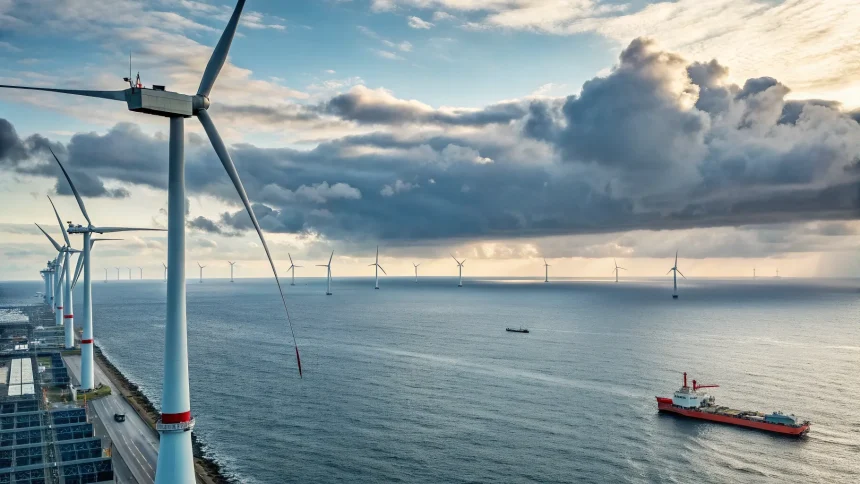
The federal government has imposed an immediate pause on leases for five large offshore wind projects along the East Coast, citing national security risks identified by the Pentagon. The decision, announced Monday in Washington, affects projects under construction and directs the Interior Department to review the risks and next steps.
The administration said it is “pausing leases for five large-scale offshore wind projects under construction in the East Coast due to unspecified national security risks identified by the Pentagon.”
Officials did not disclose the specific threats or how long the pause will last. The Interior Department is expected to coordinate with defense and homeland security agencies before any leases resume.
What prompted the pause
National security concerns tied to offshore wind often center on radar interference, maritime surveillance, and access to training areas. Large turbines can create “clutter” on coastal radar, making it harder to track aircraft and small boats. Subsea cables and high-voltage equipment may also require protective zones that overlap with military training corridors.
Defense planners have raised similar issues in past reviews of coastal energy projects. They have asked developers to adjust turbine layouts, increase radar mitigation, or carve out buffer zones to preserve radar lines of sight. Monday’s action signals a broader review, affecting five projects at once.
The pause is “effective immediately” and will “give the Interior” time to address the risks, according to the announcement.
Economic and climate stakes
The halt lands as private investment, port upgrades, and supply chain commitments have accelerated along the Atlantic seaboard. Shipyards, cable factories, and specialized installation vessels rely on predictable timelines. Any delay can ripple through contracts, permitting, and grid interconnections.
States from Massachusetts to the Carolinas have set procurement targets to add offshore wind power to their grids in the next few years. Utilities and ratepayers are watching how the pause might affect costs and delivery schedules.
- Developers face construction windows tied to weather and marine life protections.
- Ports and manufacturing sites plan hiring and training around project milestones.
- Grid operators require firm dates to manage transmission upgrades.
Security concerns vs. energy goals
National security officials argue that surveillance and training needs must remain intact. They say turbine arrays should not create gaps in radar coverage or limit exercises that prepare pilots and sailors for real-world missions.
Industry leaders typically point to established mitigation steps. These include radar software upgrades, turbine spacing changes, and data sharing with federal agencies. They also note that several European countries host dense wind farms alongside active naval operations, using agreed protocols to manage conflicts.
Energy policy analysts warn that a blanket pause can rattle investors. Contract financing often depends on steady federal and state signals. A lengthy suspension could raise borrowing costs and slow factory expansions that serve the sector.
How the review could proceed
Officials indicated that the Interior Department will work with the Pentagon to map sensitive areas and model radar impacts. The outcome could include revised lease terms or project redesigns. Timelines will hinge on how quickly agencies define mitigation standards and review each site.
Several tools are commonly considered in such reviews:
- Radar mitigation software and hardware upgrades on shore-based systems.
- Revised turbine locations to preserve clear radar corridors.
- Operational agreements for curtailment during specific training windows.
- Enhanced monitoring of vessel traffic near defense zones.
Voices and reactions
Supporters of the pause cite caution. They argue that energy projects must not compromise surveillance or training readiness. “Security first” is the message from defense advocates who want binding standards before construction advances.
Developers and port officials express concern about timing. They say clarity on mitigation is needed quickly to avoid missing construction seasons. Labor groups note that delays could stall hiring for union jobs slated for turbine assembly and installation.
What to watch next
The key questions now are the duration of the pause and the scope of mitigation required. A swift, transparent process would help developers adjust designs and hold schedules. A prolonged review could prompt contract renegotiations and push projects into later years.
The decision places security risks at the center of the offshore wind build-out. Clear standards on radar, training access, and marine surveillance would give both the Pentagon and developers a shared playbook. The faster those rules are defined, the sooner projects can proceed with fewer surprises.
For now, the pause injects uncertainty into a sector that depends on steady timelines. Agencies and developers will need to coordinate closely. The speed and clarity of the review will determine whether the current construction plans stay on track.