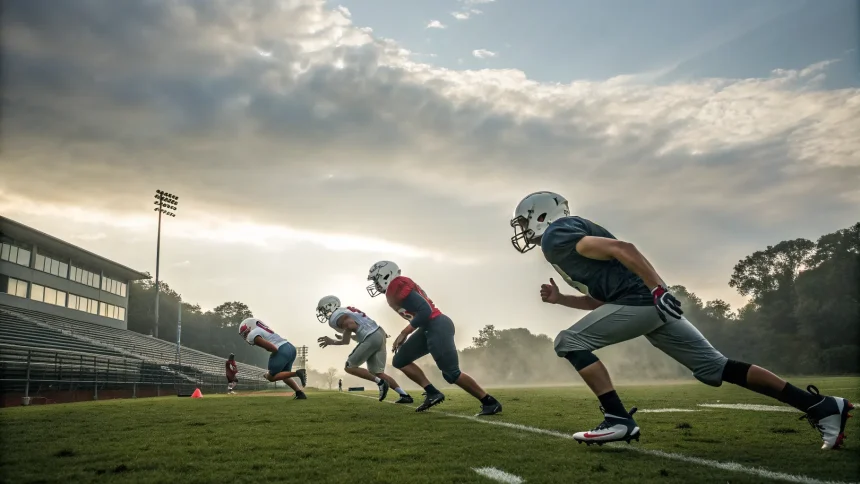
The United States built a medal machine in part by accident, and now the gears are grinding. As one line puts it, “It birthed an unexpected accelerator of Olympic development: College football.” The model that powered U.S. podium finishes for decades is facing new pressure as money, rules, and priorities shift across college sports.
For much of the modern Games, the U.S. has leaned on universities to identify, coach, and fund future Olympians. That pipeline emerged from a Cold War race that the U.S. did not plan to fight with government money. Instead, it relied on a web of college programs and private donors while rivals backed state-run systems. The setup produced champions, but new forces may be weakening its grip.
Cold War Roots Of A Medal Machine
In the mid-20th century, rival powers poured resources into national teams. The Soviet system was centralized and direct. The U.S. took a different path.
“How did the U.S. become the Olympic powerhouse it is today? Cold War competition. The Soviet Union sponsored their athletes.”
Without a federal training program, American athletes found support on campus. The NCAA offered scholarships, world-class facilities, and steady competition. Coaches in track and field, swimming, wrestling, and gymnastics built deep rosters. By the 1980s and 1990s, the system was entrenched. Universities recruited globally, raised performance standards, and fed Team USA’s depth.
The results were visible on medal tables. In recent Summer Games, the U.S. topped the standings, including 113 total medals at Tokyo 2020. More than three-quarters of American Olympians had NCAA ties, according to college sports data shared around the Games. Many trained, studied, and competed under university budgets shaped by one sport that does not feature at the Olympics: football.
How Football Quietly Funded Medals
Football’s media deals poured billions into athletic departments. That money helped pay for training centers, nutrition, sports medicine, and travel for non-revenue sports. Administrators often describe a simple equation: football fills stadiums and TV slots, and the surplus keeps Olympic sports strong.
That cross-subsidy was not uniform, but it was common. Athletes in swimming could access modern pools because a Saturday game drew 80,000 fans. Track teams flew to meets on budgets built on broadcast checks. Strength staffs, analytics, and medical support spread across programs. It was an informal national program, stitched together by conferences and TV partners rather than federal planners.
“America wanted its athletes to pull themselves up by their bootstraps.”
That philosophy fit the college model. It also left the pipeline exposed to shocks that start on the gridiron.
Cracks In The Model
The same engine now runs hot. Name, image, and likeness (NIL) deals have reshaped recruiting and budgets. Realignment has thrown travel and schedules into flux. Media money remains large but more fragmented. Some schools cut teams after the pandemic and later reversed course under pressure. Others trimmed staff or travel to balance books.
“…that engine might not be running as smoothly as it once did.”
Coaches in Olympic sports warn that facility upgrades are slowing. International recruiting faces tighter dollars and higher costs. Athletes juggle longer trips as conferences sprawl across time zones, raising concerns about rest and class time. Athletic directors counter that NIL can help retain stars and that new media deals still support broad programs, especially at the wealthiest schools.
- U.S. won 113 medals at Tokyo 2020, 39 of them gold.
- College-linked athletes made up a large majority of Team USA.
- Several schools announced Olympic-sport cuts after 2020 before restoring some teams.
What To Watch Before Paris And Los Angeles
Short term, most top programs will remain strong. The Paris Games will feature many athletes who trained under the classic college model. But pressure points are clear. If football revenues flatten or costs rise faster, departments may protect football first. That could slow hiring, shrink travel, or reduce roster spots in Olympic sports.
There are countervailing forces. The 2028 Los Angeles Games are spurring interest and potential donor support. Some conferences are exploring revenue-sharing ideas that could stabilize budgets. Athlete advocacy is growing, which may protect training standards in non-revenue sports. State NIL rules and any future federal action could also bring more predictability to planning.
Stakeholders describe a recalibration rather than a collapse. The question is whether the U.S. can keep a college-centered system that has delivered depth across many sports while adapting to new economics. The answer may determine medal counts for the next decade.
The Cold War built the structure. Football money powered it. Now choices about spending, athlete pay, and travel will test it. Watch how schools handle cuts and investments after Paris. The shape of the pipeline heading into Los Angeles 2028 will show whether the old engine still has the torque to keep the U.S. on top.