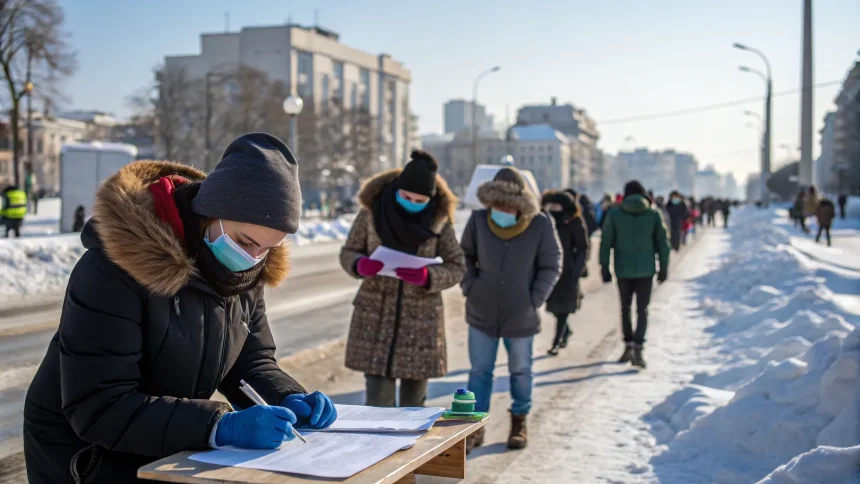
Student groups across Serbia mounted a coordinated signature drive on Sunday, urging early parliamentary elections to challenge the rule of President Aleksandar Vucic’s government. Volunteers set up stations across cities and towns despite sub-zero temperatures, aiming to sustain momentum after months of street protests.
The effort seeks an election timetable and clearer guarantees for fair voting. Organizers cast the push as a peaceful, legal way to channel anger over recent contests. Authorities describe the protests as politically driven and insist that voting procedures meet legal standards.
A growing youth-led movement
The campaign has been driven by university students who say they want a reset of Serbia’s political scene. They argue that elections held under current conditions do not allow for equal competition. The weekend’s initiative is meant to show breadth of support, not only in Belgrade but in regional centers as well.
“Braving freezing weather, the students collected signatures throughout the country for their request for an early parliamentary election,” one organizer said.
Organizers positioned the signature drive as an organizing tool and a test of reach. Many participants are first-time activists who describe the action as a stand for dignity and accountability. The government has urged calm and rejected claims of authoritarian practices.
What early elections would mean
Under Serbia’s system, early parliamentary elections can be called if the president dissolves parliament or if the ruling majority agrees. Petitions do not trigger an automatic vote but can increase public pressure. The students say the aim is to push institutions to act and to encourage parties to commit to reforms.
- Independent oversight of the voter roll
- Equal media access for opposition parties
- Clear rules on campaign financing and advertising
- Prompt investigation of reported irregularities
Legal scholars note that these steps are common requests in contested elections. They add that even modest changes to oversight and media access can shift public trust.
Context: recent elections and disputed claims
Vucic has led Serbia since 2014 as prime minister and since 2017 as president. He and his party, the Serbian Progressive Party, have maintained a strong grip on parliament. Critics accuse the government of concentrating power and limiting space for dissent, charges officials deny.
After recent votes, international observers flagged concerns about fairness and pressure on voters. The government counters that Serbia’s elections comply with the law and that results reflect the public will. Media regulators have defended their approach, while press freedom groups have urged stronger rules to limit bias.
Inside the signature drive
Students deployed paper forms and online sign-ups, aiming to build a verified list of supporters. Volunteers said turnout was steady, with many signers citing frustration over jobs, wages, and living costs. Others pointed to media bias and the need for clearer campaign rules.
Security was tight but quiet at several collection points reported by participants. Police kept a visible presence and directed traffic near larger queues. There were no immediate reports of major disruptions.
What experts are watching
Election analysts say the petition’s impact will hinge on three factors: scale, sustainability, and whether mainstream parties align with student demands. If opposition groups present a united platform, they could convert street energy into votes. Fragmentation would weaken the push for a new election.
Regional observers also watch Serbia’s relations with the European Union. Progress on rule-of-law benchmarks often shapes investment and accession talks. Clearer election rules could help, though any change depends on decisions in Belgrade.
Competing narratives
Supporters of the petition argue that early elections would refresh parliament and reduce tensions. They say the signature drive reflects civic will, not partisan orders. Government allies respond that frequent elections create instability and that reforms should go through regular committees and public hearings.
The debate is as much about trust as it is about timing. Students call for guarantees before any vote. Officials insist current institutions can deliver fairness and that democracy must run on agreed procedures.
The signature drive signals a shift from marches to institution-focused tactics. Whether it forces a new vote will rest on turnout, unity among opposition groups, and the state’s response. For now, the students have turned cold streets into a test of resolve—and set a clear marker for what they want next: a date, rules everyone accepts, and a contest that the public trusts.