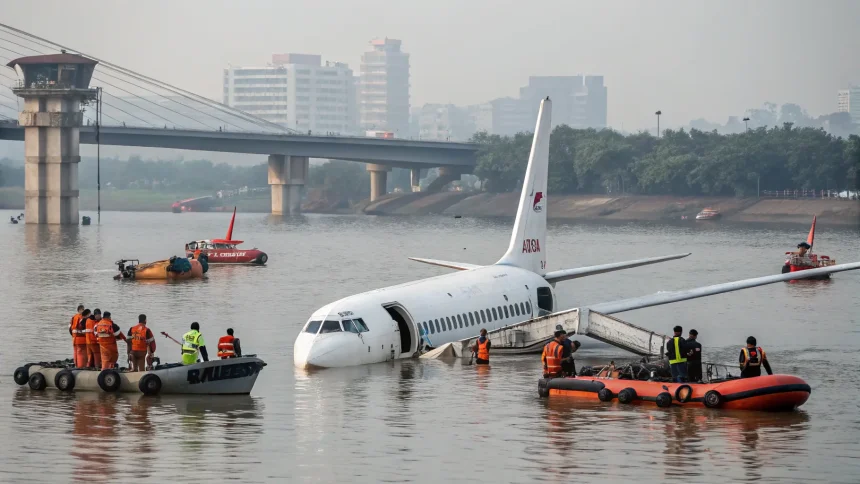
An Indian Air Force trainee aircraft made an emergency landing in a water body in Prayagraj, Uttar Pradesh, on Wednesday during a routine training sortie. Defence officials confirmed that both crew members survived without life-threatening injuries. Local authorities quickly sealed the site while recovery teams moved in, and the Air Force ordered a court of inquiry to find the cause.
The incident drew residents to the riverbank as police and disaster response teams set up a perimeter. Early accounts suggest the landing was controlled. The plane remained largely intact, according to people at the scene. The investigation will focus on what forced the crew to put down in water during a training flight.
What happened during the sortie
Officials said the crew executed an emergency procedure and guided the aircraft down over a water body near Prayagraj. The decision likely balanced the risk to the crew against the safety of people on the ground. Witnesses reported a quick response from the Air Force and district authorities.
“Both crew members onboard are safe,” defence officials said as recovery operations began.
Police cordoned off the area to manage crowds and protect the aircraft from damage or tampering. Divers and engineers assessed how to extract the plane without adding stress to the airframe or polluting local waters.
Why water landings are used in emergencies
Training missions include drills on handling sudden failures. In rare cases, pilots may choose a water landing to reduce the risk of fire and avoid populated zones. That choice can also absorb impact forces at lower speeds. It demands precise control, calm judgment, and clear communication between crew members.
Standard checklists guide pilots through engine, fuel, and control checks, while the back-seat trainee or instructor runs verification steps. The inquiry will review whether those procedures were followed and how much time the crew had to act.
Response and recovery efforts
Authorities formed a unified command on the bank, linking the Air Force, police, and local disaster teams. The goals were simple: secure the crew, secure the site, and secure the evidence.
- Medical checks for both crew members.
- Site perimeter and crowd control.
- Fuel containment and environmental monitoring.
- Aircraft recovery planning and towing routes.
Such steps protect residents, prevent leaks, and preserve data for investigators. The cockpit voice recorder, flight data, and maintenance logs will be central to the review.
The court of inquiry: what investigators will examine
The Air Force’s court of inquiry is the standard process after any incident. It gathers pilot statements, weather data, and technical reports. It also studies training schedules and recent maintenance actions.
Key questions include:
- Did a mechanical issue prompt the emergency?
- Were weather or bird activity factors?
- Did the crew receive any warning lights or irregular readings?
- Were standard emergency steps followed in sequence?
Findings often lead to targeted training refreshers, minor technical fixes, or updates to checklists. When needed, they result in changes to parts inspection cycles.
Training risk and safety record
Military flight training carries risk, but it is structured to manage that risk. Instructors and trainees fly planned routes, use layered checklists, and maintain radio contact. Emergency drills are part of the syllabus, stressing calm decision-making and crew coordination.
Water recoveries are complex and can take several days. Recovery crews must keep the airframe stable as they lift it clear of mud or shifting currents. They also work to prevent any fuel seepage into the water.
What comes next
The Air Force will publish its findings after the court of inquiry completes its work. Any recommendations will be circulated across training units. Local authorities are expected to reopen the site after recovery and environmental checks.
“Recovery operations began,” an official noted, adding that the area was cordoned off to support the investigation.
This incident will likely feed back into training lessons on forced landings and low-altitude decision-making. It may also bring a review of routes near water bodies and densely populated areas.
For now, the focus remains on the crew’s safe return and a clear explanation of the emergency. The inquiry’s report will guide next steps, from maintenance actions to updated flight briefings. Residents and aviation watchers will look for answers on what triggered the landing, how the crew managed the descent, and what changes, if any, will follow.