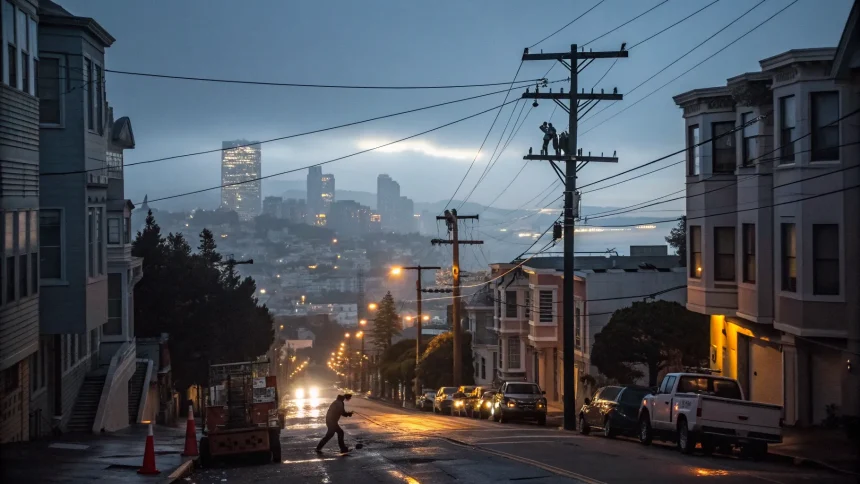
San Francisco faced a sweeping power failure Saturday, with electricity cut to an estimated 130,000 homes and businesses across the city. The outage affected roughly one-third of Pacific Gas and Electric Co. customers, disrupting daily life in one of the nation’s busiest urban centers. City officials and utility crews focused on restoring service and assessing the broader strain on residents and local commerce.
A massive outage has knocked out power to 130,000 homes and businesses in San Francisco.
The outage Saturday represents roughly one-third of Pacific Gas and Electric Co’s customers in the city.
Scale and scope of the shutdown
The scale of the outage set it apart from more routine service disruptions. With about a third of customers affected, entire neighborhoods likely experienced darkened traffic signals, shuttered storefronts, and interrupted public services. While essential facilities are typically backed by generators, widespread power loss can strain emergency response and transit operations.
The timing on a weekend may limit commuter delays, but it can hit restaurants, retailers, and venues during peak hours. For many small businesses, a lost day of sales can be hard to absorb. Residents also face worries about food spoilage, medical devices, and connectivity as batteries drain.
What caused the outage?
Officials had not released a cause as of Saturday. Large outages can stem from equipment failure, weather, substation issues, or construction damage. Urban grids are complex, and one fault can cascade if protection systems trip to prevent further harm. Investigators will look at where the first failure occurred and how it spread through the network.
Utilities often prioritize restoring power to the largest number of customers first, then address smaller pockets. Crews typically isolate damaged segments, inspect lines and substations, and bring circuits back in stages to avoid overloads.
Immediate impact on residents and businesses
For households, the top concerns are safety, communication, and refrigeration. Businesses must manage staff, protect inventory, and notify customers. Without clear restoration timelines, many hedge by closing early or limiting services.
- Use flashlights instead of candles to reduce fire risk.
- Keep refrigerator and freezer doors closed to preserve cold air.
- Avoid driving through dark intersections unless directed; treat them as four-way stops.
- Check on neighbors who may need help, especially older adults and those using medical equipment.
Cell networks may hold up initially, but towers can falter as backup power runs low. Public charging stations and community centers, if operating, can become key hubs.
PG&E’s reliability challenges and ongoing efforts
PG&E serves a large, dense territory with aging infrastructure in many areas. The utility has faced long-running pressure to improve reliability and safety. In recent years it has discussed grid hardening, equipment inspections, and targeted upgrades meant to reduce failures and shorten outages.
Urban networks present unique challenges. Underground lines are better protected from storms but can be harder to repair. Above-ground lines are easier to access but more exposed. Balancing speed of repair, cost, and reliability is a constant trade-off for utilities and regulators.
Economic and social ripple effects
Short outages can be inconvenient; broader and longer ones can carry real economic costs. Restaurants may throw out inventory. Shops lose card processing and foot traffic. Workers on hourly wages can miss shifts. The combined effect across a third of the city’s customers can be substantial even if power returns the same day.
For vulnerable residents, prolonged outages compound risks. Those relying on refrigerated medications or powered medical devices face urgent needs. Community groups often step in, providing wellness checks and charging options when available.
What to watch in the hours ahead
The key questions are how quickly service returns, whether the outage recurs, and what the root cause proves to be. Clear communication from the utility and local agencies will guide safety steps and set expectations for businesses planning the week ahead.
Officials typically release a preliminary assessment within hours of a major disruption, followed by a more detailed review. If the issue involves a substation or critical line, repairs can take longer and restorations may come in waves.
San Francisco’s experience with this event will likely inform future planning, from backup power needs to maintenance schedules. Residents and businesses will watch closely for lessons on grid resilience and how similar disruptions can be minimized.
As power returns, the immediate priority is safety and accurate information. The longer-term discussion will focus on preventing a repeat and strengthening a system that supports a city of global importance.