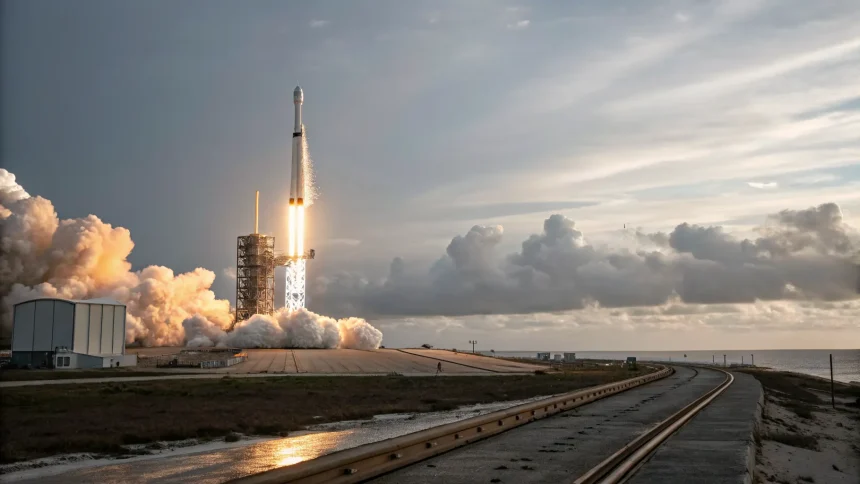
SpaceX is weighing a public listing that could rank as the largest on record, stoking debate over whether the numbers support a debut of that scale. Investors and analysts are asking if the company’s mix of launch services and satellite internet can justify a flotation that might top Saudi Aramco’s 2019 record.
“SpaceX is eyeing the largest IPO in history. But does the math add up, or is the market getting overhyped about another Elon Musk moonshot?”
The company, led by Elon Musk, has raised large sums in private markets and reached a valuation reported well above $150 billion. Any decision on timing remains closely guarded. The key question is how much equity SpaceX would sell and whether public markets are ready to absorb it.
Background: A Private Giant Nears a Public Test
SpaceX has scaled from a niche launcher into a dominant provider for commercial and government customers. It has become central to U.S. access to orbit following the retirement of older rockets and delays at rivals. The company’s next act is Starlink, a satellite network that sells broadband to homes, businesses, and governments in dozens of countries.
The largest initial public offering to date raised about $29.4 billion for Saudi Aramco in 2019. SpaceX’s private valuation has climbed through recurring tender offers, reflecting growth in launch revenue and the rapid expansion of Starlink. Musk has previously signaled that Starlink could list once cash flows are stable, but he has pushed back on near-term timelines.
The Math Behind a Record Listing
Whether SpaceX can set a record depends on two variables: the company’s valuation at pricing and the portion sold in the offering. A high valuation alone does not guarantee record proceeds if the float is small.
- At a $200 billion valuation and a 10% float, proceeds would be about $20 billion.
- At a $220 billion valuation and a 15% float, proceeds could reach $33 billion.
- At a $180 billion valuation and a 10% float, proceeds would be about $18 billion.
Those simple cases show the trade-off. To surpass Aramco on proceeds, SpaceX would need either a higher valuation, a larger float, or both. Liquidity needs, governance choices, and market appetite will shape that decision.
Starlink’s Role and Capital Demands
Starlink is the swing factor. It has millions of subscribers and a rising enterprise and government customer base. Revenue growth has been steady as coverage and product offerings expand, including maritime, aviation, and mobile options. But the network is capital intensive. It requires frequent satellite replenishment and sustained launch cadence.
Starship, the next-generation rocket, is designed to reduce launch costs and lift capacity if it reaches regular operations. That could lower the expense of maintaining and upgrading Starlink. Until then, cash needs remain high. Investors will look for proof that equipment costs are falling, churn is low, and average revenue per user is stable or rising.
Risks, Governance, and Public Scrutiny
Bringing SpaceX to public markets would invite more scrutiny of financials, margins, and safety records. The company must manage complex regulatory issues across launch operations and international telecom rules. Competition is growing in satellite broadband and government launch contracts.
Governance will also draw attention. Musk leads several high-profile companies, and investors may ask how leadership time and decision-making are structured. Clear disclosure on board independence, related-party dealings, and capital allocation would help address those concerns.
Market Conditions and Timing
The IPO market has shown signs of recovery after a slow period, but large offerings still need a supportive backdrop. Institutional buyers will weigh SpaceX’s growth profile against rate expectations, equity volatility, and sector rotation. A dual-track option—listing only Starlink first—could narrow the story and set a clearer path to profitability, though it would separate two tightly linked businesses.
What Investors Will Watch
- Revenue mix: Launch versus Starlink and visibility on multi-year contracts.
- Unit economics: Terminal hardware cost trends and customer payback periods.
- Capital plan: Starship milestones, satellite replenishment cadence, and funding needs.
- Regulatory status: Spectrum rights, export controls, and safety compliance.
- Governance: Board structure and alignment with public shareholders.
If SpaceX pursues the largest IPO on record, the offering will hinge on credible, detailed financials and a convincing path to durable cash flow from Starlink. Without that, even strong demand may not support a record float. With it, the listing could reset expectations for space and telecom companies alike.
For now, the market waits on timing, structure, and disclosures. The next signals to watch are any moves to separate Starlink, Starship test progress, and fresh tender-offer pricing. Those steps will tell investors whether the math supports a record or whether hype is running ahead of the story.