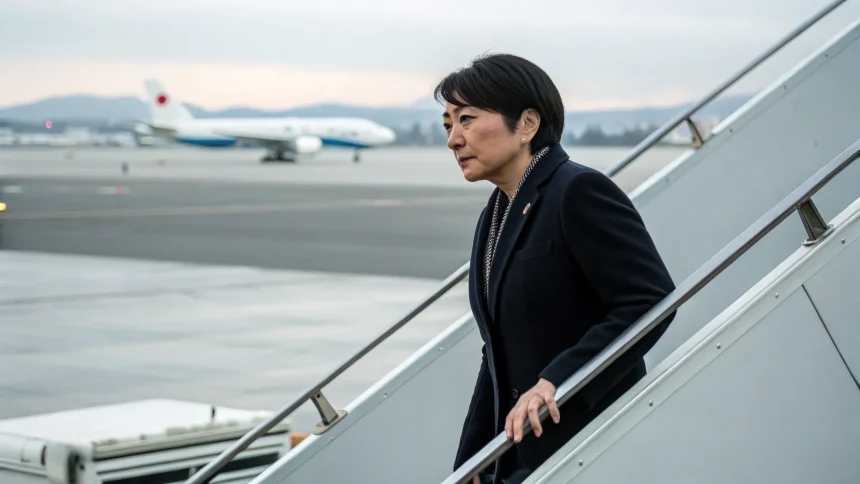
Japanese Prime Minister Sanae Takaichi departs for Washington on Wednesday, bracing for what she called a “very difficult” meeting with U.S. President Donald Trump. The talks come after Trump urged Japan and other allies to send warships to protect shipping in the Strait of Hormuz, a vital chokepoint for global oil flows. The three-day visit places Japan’s security policy and energy supply in sharp focus as both sides seek common ground.
Why Hormuz matters to Tokyo
The Strait of Hormuz is one of the world’s most important shipping routes. Tankers carrying a large share of global crude pass through its narrow waters. Japan relies heavily on Middle Eastern oil, and any disruption could raise prices and strain its economy.
Trump’s appeal for allied naval support is not new. Similar calls surfaced during past Gulf tensions and tanker incidents. But the request forces Japan to weigh alliance expectations against legal limits set by its postwar constitution.
The request and the response
“Very difficult,” Prime Minister Takaichi said of the planned White House meeting.
Her choice of words signals that Washington’s ask will test Tokyo’s political and legal boundaries. Trump has pressed partners to do more for shared security, and this time he wants ships near Hormuz.
He called on Japan and other allies to “send warships to secure the Strait of Hormuz.”
Japan has sent forces to the broader region before, usually for non-combat tasks. Maritime Self-Defense Force destroyers have conducted anti-piracy patrols in the Gulf of Aden. Surveillance flights and information-sharing have been part of that approach. Direct participation in potential combat near Iran’s coast would be far tougher to justify at home.
Legal limits and political debate
Article 9 of Japan’s constitution renounces war and limits the use of force. Reforms in recent years allowed limited collective self-defense, but only when Japan’s survival is at risk. Lawmakers would likely argue for a strictly defensive, independent mission focused on information gathering.
Opposition parties may resist any move that appears to back U.S. pressure on Iran. Business groups, worried about energy costs, want safe shipping but also stability with regional powers. The ruling bloc faces a careful balancing act between alliance unity and domestic law.
What options are on the table
Officials and policy experts point to a menu of choices that could meet U.S. concerns without crossing red lines. Tokyo could send a destroyer and patrol aircraft for intelligence and escort duties under Japan’s own rules of engagement. It could expand maritime surveillance around, but not inside, the tightest part of the strait. It could also boost support for multinational information-sharing and logistics outside direct combat zones.
- Independent maritime surveillance and information-sharing
- Limited naval presence focused on escort and deterrence
- Greater diplomatic outreach to calm regional tensions
Regional risks and global markets
Any crisis in Hormuz can move oil markets within hours. Even a minor incident can raise insurance costs for tankers and push up fuel prices. For a trade-dependent nation, that is a direct hit to households and industry.
Security analysts warn that miscalculation could draw navies into unintended clashes. Japan’s preference has been steadying diplomacy with Gulf states and quiet maritime support at a distance. The aim is to keep ships safe without being pulled into a shooting conflict.
Alliance signals and the road ahead
Takaichi’s visit will also be read as a test of alliance management. The United States seeks visible commitments from allies; Japan seeks recognition of its legal constraints and past contributions. A carefully crafted joint statement could outline steps short of direct combat patrols.
Both sides are likely to highlight shared goals: open sea lanes, lower risk to crews, and a stable energy market. The details will matter. Even a small deployment signals resolve to Washington and markets, while a larger one may invite domestic pushback and regional friction.
As Takaichi lands in Washington, the stakes are plain. She must protect Japan’s energy lifeline, respect the constitution, and keep the U.S. alliance on steady footing. A measured plan that pairs limited naval support with active diplomacy may offer the narrow path forward. Watch for language on independent operations, information-sharing, and de-escalation. Those clues will show how Tokyo plans to keep oil flowing without drifting into war.