

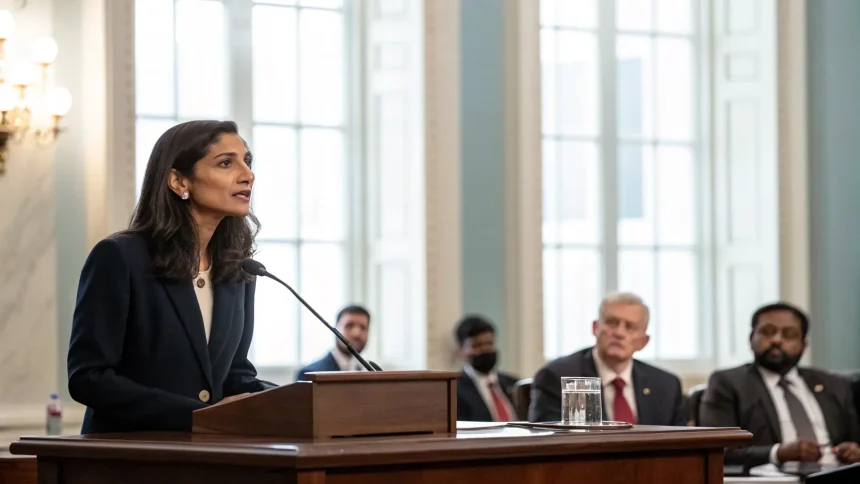
At a high-profile hearing in Washington, South Asia expert Lindsey Ford urged U.S. policymakers not to push India into a sudden break with Russia on defense. Speaking before the U.S.-China Economic and Security Review Commission, she warned that sharp pressure without credible alternatives could erode India’s security as it manages a tense border with China and a growing maritime role in the Indo-Pacific. Her message was direct: the United States should reinforce, not strain, defense ties with New Delhi at a sensitive moment.
Why India’s Defense Choices Matter
India is one of the few major powers that must defend a long, contested frontier with China while also policing vital sea lanes. Its military readiness affects stability from the Himalayas to the Indian Ocean. For decades, India has sourced key platforms and spare parts from Russia. That legacy creates supply chains and maintenance needs that are not easy to replace quickly.
Washington has sought closer cooperation with India in recent years. The two countries have expanded joint exercises, logistics agreements, and technology discussions. Yet the shift is still underway. India continues to balance legacy equipment with newer partnerships, a process that takes planning, time, and trust.
What Ford Told Commissioners
“[Do not] pressure India to abruptly cut defence ties with Russia,” Ford said, arguing that this could backfire without “credible U.S. alternatives.”
She tied her warning to immediate security needs. India faces recurring friction along its border with China and is a key actor in the Indo-Pacific. Any disruption in its military supplies, maintenance, or training could create gaps that adversaries might exploit.
“Forcing rapid diversification could weaken India’s security,” she added, calling instead for policies that shore up bilateral cooperation.
Ford framed the issue as part of a wider strategic contest. The goal, she said, should be practical steps that strengthen India’s capacity, not symbolic measures that leave it exposed.
Competing Views in Washington
Some U.S. voices argue that India must reduce dependence on Russian arms as a matter of principle and long-term security. They see tighter alignment with the United States as both strategic and values-driven. They also point to the risks of relying on Russian parts during global tensions.
Ford offered a different emphasis. She did not dismiss diversification. Instead, she argued that timing and credible replacement options are crucial. Abrupt moves could strain India’s readiness, damage trust, and slow the very shift Washington hopes to see.
Strategic Stakes in the Indo-Pacific
India’s naval presence helps secure shipping routes and deter coercion. Its army must be ready for high-altitude operations and rapid mobilization. Both missions require reliable supplies, training pipelines, and maintenance cycles.
Ford’s testimony linked these needs to U.S. policy choices. If Washington wants a stronger partner, it should help close capability gaps in ways New Delhi can absorb. That means realistic timelines and genuine offers that meet immediate requirements.
Policy Options for the United States
- Offer near-term equipment and spares that match India’s operational needs.
- Expand co-production and co-development to build self-reliance in India.
- Streamline export approvals to reduce delays on critical systems.
- Increase training, maintenance, and logistics support for sustained readiness.
- Map phased diversification so legacy systems can be replaced without gaps.
Quotes That Framed the Debate
“Strengthening, not straining, US-India defence cooperation is critical in a shifting global order.”
Ford’s remarks aimed to reset expectations. Pressure without a plan, she suggested, creates risk. A supportive approach tied to concrete deliveries can improve trust and performance.
What to Watch Next
Observers will look for practical steps from Washington. Faster approvals, clearer financing, and joint production announcements would signal follow-through. New Delhi, for its part, will gauge whether U.S. offers are reliable and timely enough to justify faster shifts in procurement.
If the two sides align on a phased plan, India can modernize while staying ready along its border and at sea. If they do not, the debate over Russia ties may harden, with little gain for either side.
Ford’s core point was simple. Strategy should be guided by outcomes in the field. Measured support that strengthens India today is more likely to build the partnership both countries say they want tomorrow.