

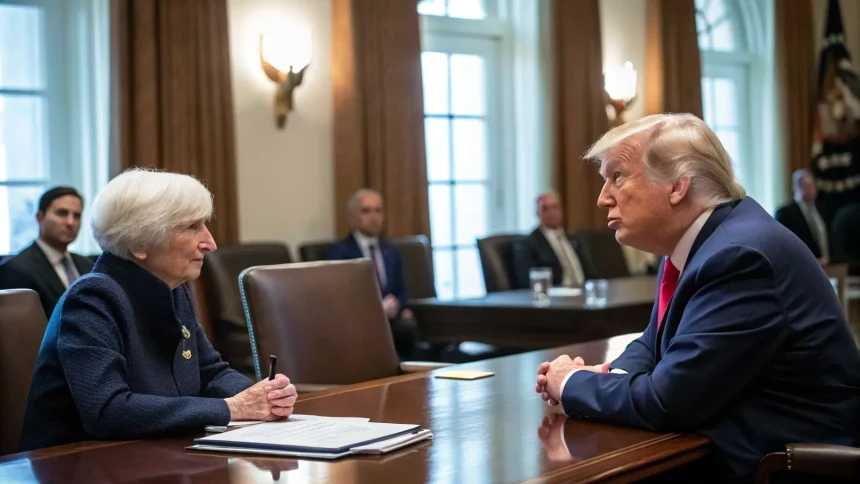
President Donald Trump’s reported effort to remove Federal Reserve Governor Lisa Cook has set off a high-stakes fight over central bank independence and presidential power. The dispute centers on whether a president can dismiss a sitting governor outside the narrow bounds set by law and long practice. The move has drawn swift scrutiny because it could shift how the world’s most influential central bank operates and communicates.
At issue are President Trump’s efforts to break with 112 years of law and precedent by firing Lisa Cook, a member of the Federal Reserve’s governing board.
Central Bank Independence at the Forefront
The Federal Reserve was designed to stand apart from short-term political pressure. Governors serve long, staggered terms to promote stable policy and public confidence. While the White House appoints governors and the Senate confirms them, the Fed sets interest rates and regulates banks without direct presidential control.
That structure has been tested before. Presidents have criticized policy choices, met privately with chairs, and aired frustrations in public. But direct attempts to remove a governor have been rare, if not unheard of. That history helped build the Fed’s reputation as an independent institution focused on inflation, employment, and financial stability.
The Law and the Limits of Removal
Under the Federal Reserve Act, a president may remove a governor “for cause.” Legal experts often interpret that as misconduct or incapacity, not policy disagreements. The phrase is intentionally narrow to protect decision-making from politics.
Any move to fire a sitting governor would likely face immediate legal challenge. Courts would be asked to define “cause” and weigh it against the need for central bank independence. A ruling could set a lasting standard for how far a president can go in reshaping monetary policy leadership between elections.
Why Lisa Cook’s Seat Matters
Lisa Cook, an economist and member of the Board of Governors, helps guide interest rate policy and regulatory oversight. Her vote, analysis, and public remarks influence how investors, banks, and households read the Fed’s path on inflation and growth. Removing a sitting governor could shift the balance of views on rates, bank rules, and climate-related financial risk.
It could also affect how global markets read U.S. policy. Any perception that monetary decisions are swayed by political pressure can raise borrowing costs, weaken credibility, and disrupt planning for businesses and consumers.
Market and Policy Implications
Investors watch the Fed’s independence closely. If a dismissal proceeds, traders may price in higher risk premiums. The dollar, Treasury yields, and equities could move on concerns about policy stability. Central banks in other countries might react by emphasizing their own independence to steady markets.
- Higher market volatility if independence is questioned.
- Legal uncertainty that clouds near-term policy signals.
- Potential chill on future recruitment of qualified governors.
On Main Street, uncertainty about rates can ripple into mortgage costs, auto loans, and small business financing. Even if policy does not change, the perception of political sway can affect behavior.
Competing Views and What Experts Say
Supporters of a hard-line approach argue elected leaders should have more say over agencies that shape the economy. They say accountability matters when inflation or growth miss goals.
Critics warn that central banks work best when insulated from day-to-day politics. They point to decades of research finding that independence helps keep inflation in check and smooths economic cycles. They also note that removing a governor over policy would deter open debate inside the Fed.
What Comes Next
If the attempt advances, several steps are likely. The administration would need to state a specific cause. The governor could challenge the action. Courts would then decide how the statute applies. Congress may also weigh in, seeking clarity on the limits of presidential power over the Fed.
The outcome will shape not only one seat, but also the guardrails that protect monetary policy from politics. It will be watched by markets, foreign central banks, and voters who feel the impact of interest rates in daily life.
The central question is whether the guardrails hold. A legal fight over a Federal Reserve governor would redraw lines that have guided Washington for more than a century. The decision will signal how the United States balances political accountability with steady, independent economic policy. Readers should watch for any formal notice of removal, the stated grounds, and the first court rulings. Those steps will tell whether this challenge fades or rewrites the rules of central banking.