

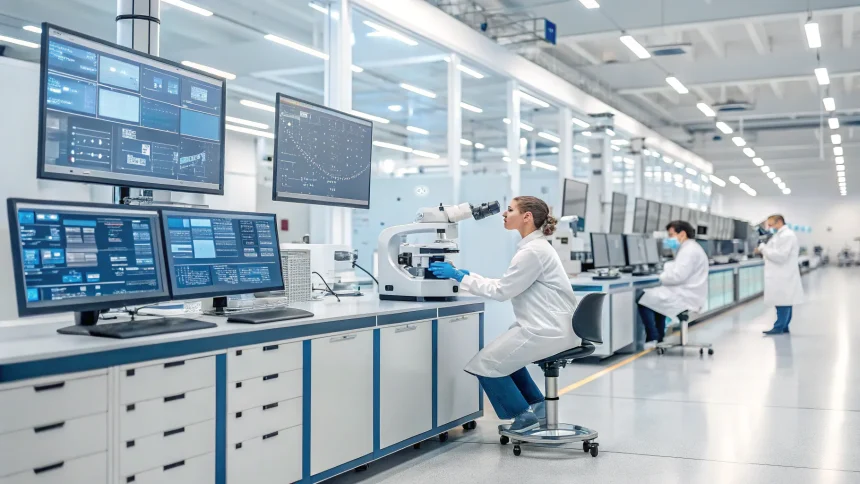
Isomorphic Labs is pushing artificial intelligence deeper into drug discovery, aiming to shrink timelines from years to months and cut costs across the pipeline. The Alphabet-owned company, led by AI scientist Demis Hassabis, is expanding work that links protein science with machine learning. The goal is faster medicines for patients and clearer decisions for researchers.
The effort comes as large drugmakers seek new ways to find targets and design molecules. It also follows major advances in protein structure prediction from Google DeepMind, which Hassabis co-founded. If successful, the approach could change how early research is done and how companies choose which drugs to advance.
What Isomorphic Says It Is Building
“At Isomorphic, Nobel Prize-winner Demis Hassabis are building AI models designed to speed up drug discovery and bring medicines to market faster.”
The statement captures the intent: use AI to learn from biology and reduce trial-and-error in early research. Hassabis has not received a Nobel Prize, but he is widely known for work on AlphaFold, a system that predicts protein structures with high accuracy.
Background: From AlphaFold to Drug Programs
AlphaFold 2, released in 2021 by DeepMind, predicted structures for hundreds of thousands of proteins. Scientists used it to map targets linked to cancer, infections, and rare diseases. In 2024, researchers unveiled AlphaFold 3, which models how proteins, DNA, RNA, and small molecules may interact. That advance supports screening and design tasks relevant to new therapies.
Isomorphic Labs launched in 2021 to apply these ideas to drug projects. The company focuses on generative models, physics-informed tools, and multi-modal training on protein, ligand, and assay data. The aim is to rank targets, propose molecules, and prioritize experiments.
Deals Signal Industry Demand
Drugmakers are investing in these methods. In 2024, Isomorphic Labs announced research collaborations with Eli Lilly and Novartis. The deals include potential milestone payments in the billions, tied to program progress and approvals. The companies plan to combine Isomorphic’s models with in-house biology and chemistry.
- Pharma seeks faster hit finding and lead optimization.
- AI tools promise to reduce failed experiments and costs.
- Partnerships spread risk across several targets.
For investors and patients, the key test is whether these tools lead to clinical candidates that work in humans. Early wins would build confidence across the sector.
Promise and Constraints
AI can help explain binding pockets, predict off-target risks, and suggest new scaffolds. It can also absorb noisy lab data and find patterns that are hard to spot. Yet biology is complex, and models trained on historical data may repeat past gaps. Predictions still need wet-lab proof and careful controls.
Regulators will look for clear evidence that AI choices improve safety and efficacy. Sponsors must document data sources, model versions, and how predictions guided decisions. Clinical trials will remain the final judge.
Independent experts caution against hype. AI may reduce some steps, but many programs fail in Phase II and Phase III. Good data, reproducible assays, and a strong study design still matter most.
What Success Could Look Like
Short-term gains may come from better triage. Teams can drop weak targets earlier and focus resources on stronger ones. AI-guided design could also improve properties like solubility and selectivity.
Longer term, integrated models could track from gene to disease to molecule to patient subgroup. That could support smarter trial enrollment and adaptive dosing. Companies that align modeling with lab work may see the largest gains.
The push by Isomorphic Labs highlights a clear trend: AI is moving from demos to drug programs with budgets and timelines. The company’s claim to “bring medicines to market faster” sets a high bar that will require lab proof and clinical data. Watch for the first molecules from these partnerships, clarity on how models improved decisions, and any measurable cut in discovery time. If the early projects deliver, AI could become a standard tool in pharma’s toolkit.