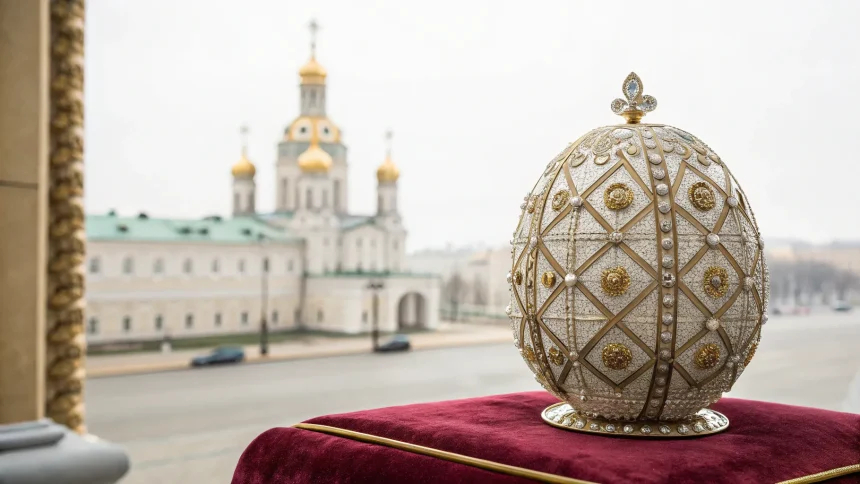
One lavish object still tells a story of power, art, and upheaval in Russia’s final imperial years. The Imperial Winter Egg, commissioned in 1913 by Tsar Nicholas II, remains a touchstone for collectors and curators who track the fate of royal treasures scattered by revolution and sold across the world.
The piece, crafted by the House of Fabergé, reflects the Romanovs on the eve of war and collapse. It also charts the rise of a global market that prizes rare craftsmanship. The egg’s journey raises questions over who should own such works and how the public can see them.
The Imperial Winter Egg with 4,500 diamonds was commissioned by Russia’s Tsar Nicholas II in 1913.
A jewel of a fading empire
The egg was created during the tercentenary of the Romanov dynasty. It was a year of celebration and strain. Russia projected stability while social pressure and political unrest simmered.
Fabergé’s imperial eggs began in 1885 under Alexander III and continued under Nicholas II. About 50 imperial eggs were produced, and most survived. Many were later dispersed after 1917, as the new government sold valuables to raise funds.
Historians often view the 1913 commission as a high point of court luxury. It arrived only months before the First World War reshaped Europe and pushed Russia toward revolution.
Craft and scale
Experts describe the Winter Egg as a tour de force of materials and precision. It combines rock crystal and platinum with a dense pavé of diamonds.
The diamond count—4,500 stones—signals the scale of its design. The work likely took months of planning and many skilled hands to complete. Fabergé’s workshops were known for goldsmiths, stone carvers, and jewel setters working in close coordination.
- Year: 1913
- Patron: Tsar Nicholas II
- Attribution: House of Fabergé
- Materials: Rock crystal, platinum, diamonds
- Reported diamond count: 4,500
Curators say such pieces show both art and engineering. Each part must fit and function, while also creating a unified design that reads as one object.
From palace to auction block
After the revolution, imperial holdings were cataloged and sold, sending many eggs into private hands. As a result, museum access varies widely.
In the early 2000s, auction records demonstrated the strength of demand for Fabergé. Sales at major houses crossed into multi-million-dollar territory, with the Winter Egg reported among the top results of its time. Collectors cited rarity, provenance, and the cultural weight of the Romanov name.
Dealers point to a steady collector base across Europe, the United States, and the Middle East. Museums in Russia and the United States hold significant groups, yet several famous examples remain in private collections.
Debate over access and heritage
The egg’s story also touches on the public’s right to see national art. Museum leaders argue that masterworks tied to world history should be on view.
Some curators call for more loans and traveling shows. They say that wider access encourages research and helps the public connect art with historical events.
Collectors counter that private stewardship has preserved rare objects during turbulent times. They also note that loans can expose fragile works to risk.
Cultural policy experts see room for middle ground. They suggest long-term loans to major museums, paired with digital archives and high-resolution imaging that allow global access without constant travel.
What to watch next
Several trends will shape the future of pieces like the Winter Egg. First, provenance research continues to grow. Buyers expect documented histories that track an object’s path.
Second, museum partnerships are likely to expand. Institutions are testing shared custody, rotating displays, and joint exhibitions that split costs and risks.
Third, market pricing may hinge on geopolitical shifts. Restrictions, sanctions, and insurance costs can affect where and how high-value items trade.
Finally, digital tools are improving public access. Detailed scans, 3D models, and guided virtual tours can bring rare objects into classrooms and homes.
The Imperial Winter Egg still carries a message from 1913: art can shine even as political systems strain. Its diamonds reflect both dazzling skill and the weight of history. As collectors and museums negotiate the next chapter, the central questions remain clear—who gets to see it, and what does the world learn when it does?